
Cobot vs Industrial Robot: A Malaysian manufacturer’s decision guide
Not sure whether a cobot or an industrial robot fits your factory? Compare task requirements, throughput, payload, flexibility, safety and total cost before deciding.
Cobot vs Industrial Robot: A Malaysian manufacturer’s decision guide
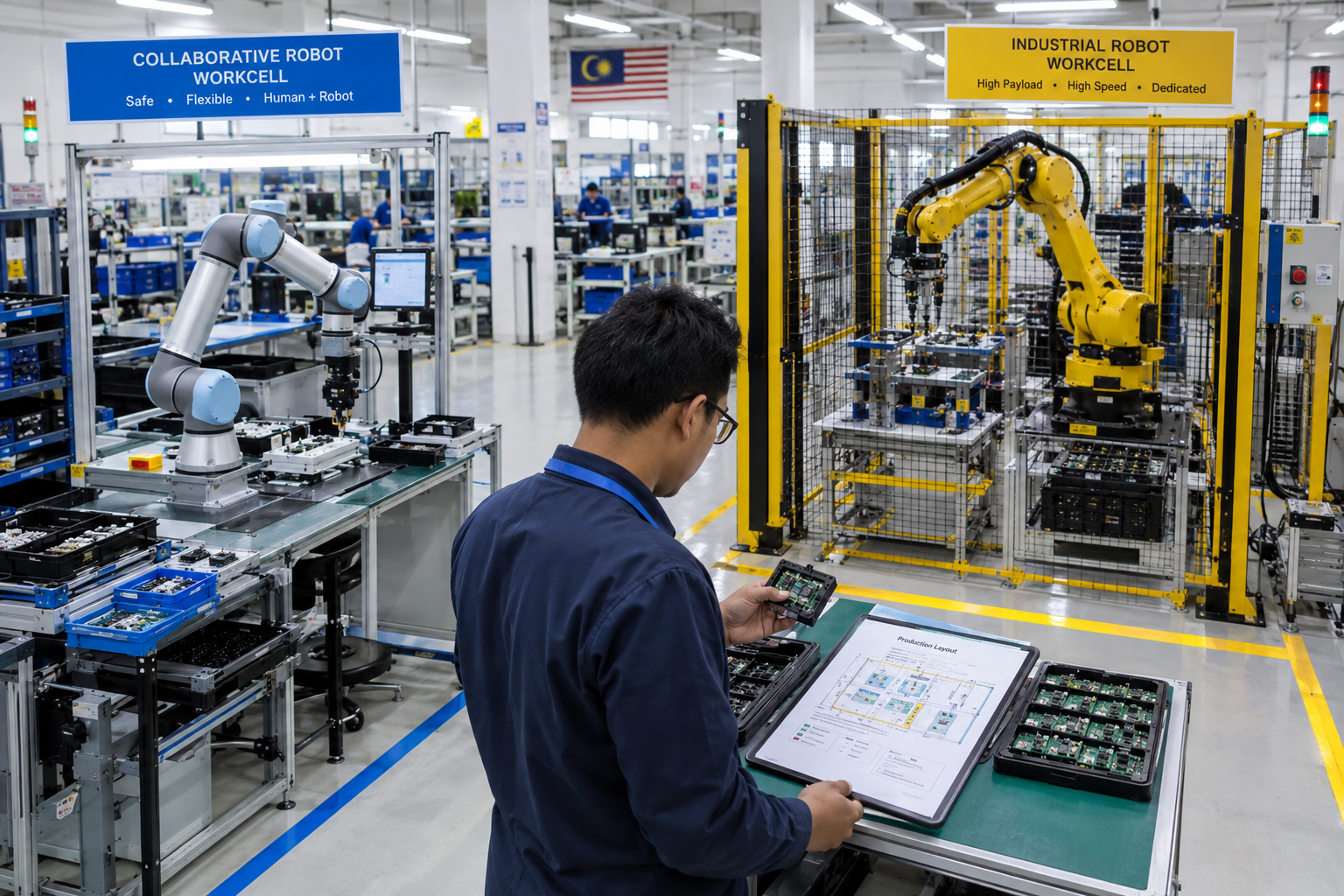
Choose a cobot when flexibility, frequent changeovers and controlled operator interaction matter more than maximum dedicated-cell throughput. Choose a conventional industrial robot when the task is dominated by speed, heavy lifting, long reach or continuous production. Neither label is enough on its own: the decision should be based on the workpiece, cycle-time target, payload, workspace, operating pattern and safety design.
In industrial automation, a “cobot” commonly refers to a robot designed for collaborative applications, not a guarantee that every task can be performed safely beside people. What matters is the complete application, including tooling, safeguards and operator access. For a Malaysian factory, the practical question is which workcell fits the process.
Cobot vs industrial robot: compare the application, not the label
Start by documenting what the robot must do and how people will interact with the process. A high-mix assembly station may value easier redeployment and operator access. A repetitive, high-volume operation may place greater value on speed, payload and continuous output. A machine-tending task may require a different balance again, depending on loading frequency, part variation and access arrangements.
For a first comparison, separate the robot arm from the rest of the cell. The end-effector, fixtures, sensors, vision system, machine interface, safety controls, programming and commissioning can materially affect the project. Comparing arm purchase prices alone does not show whether either option is suitable or economical.
Decision table: which robot type fits the task?
| Decision factor | Cobot may fit when… | Industrial robot may fit when… |
|---|---|---|
| Production pattern | Products or tasks change regularly and redeployment is important. | The process is stable, repetitive and designed around a dedicated cell. |
| Operator interaction | People need to work near the station under defined and validated conditions. | The process can be separated through guarding or controlled access. |
| Throughput priority | The required output is compatible with the proposed cobot workcell. | Raw speed or maximum continuous throughput is the main constraint. |
| Payload and reach | The workpiece, tooling and required reach fit the selected application. | Heavy lifting, longer reach or demanding movement makes a conventional cell more suitable. |
| Project design | A flexible station and simpler relocation are valuable to the operation. | A fixed layout can justify a more dedicated, performance-led solution. |
| Cost comparison | Installation, changeover and operator-interaction benefits support the complete business case. | Higher throughput or payload may produce better value for the required output. |
When a cobot may be the better fit
A cobot may be worth shortlisting for high-mix, lower-volume assembly or machine-tending work where people still load parts, perform quality checks or handle exceptions. It can also suit an operation that expects regular product changes and needs the station to be repositioned or adapted. These are application conditions, not guarantees of performance.
For Malaysian SMEs, flexibility may be particularly important when a single station must support more than one task. However, the required cycle time, payload, reach and tooling must still be tested against the actual workpiece. A cobot should not be selected simply because it appears easier to install or because it is marketed as collaborative.
Consider also how the workforce will use the system. Automation may assist people, reduce monotonous handling or allow workers to move towards higher-value activities, but it does not automatically remove the need for loading, inspection, troubleshooting or exception handling.
When a conventional industrial robot may be the better fit
Shortlist a conventional industrial robot when the application prioritises high speed, heavy lifting, long reach or maximum continuous throughput in a dedicated manufacturing cell. This direction is more likely to suit a stable, high-volume operation where the layout, tooling and access arrangements can be designed around the robot.
That does not mean an industrial robot is always the correct choice for a demanding process. The proposed arm, end-effector and cell still need to be matched to the workpiece, motion envelope, duty pattern and production target. Ask the integrator to show how the proposed cycle is achieved with the actual part and tooling rather than relying on a catalogue description.
Safety and integration: collaborative does not mean automatically safe
A cobot should not be treated as automatically safe because it is marketed as collaborative. The published ISO/TS 15066 scope describes safety requirements for collaborative industrial robot systems and their work environments; but it does not establish that a particular installation is safe. The complete application should be reviewed against applicable safety requirements, the equipment manufacturer’s instructions and a documented, application-specific risk assessment.
Before production, assess the complete cell, including the robot, end-effector, workpiece, fixtures, sensors, access points, connected equipment and operating procedures. The U.S. OSHA Industrial Robot Safety Technical Manual identifies hazards involving sharp edges on end-effectors or fixtures, workpieces released by grippers, and unexpected robot or peripheral-equipment movements. These are hazards to consider during the site-specific assessment, not evidence that every installation has them. Have a competent professional determine and validate the safeguarding measures appropriate to the actual application. OSHA is cited as a technical reference, not as a statement of Malaysian legal requirements.
Questions to resolve before accepting a collaborative design
- Will people and the robot share a workspace, or can access be controlled?
- What happens if the workpiece is dropped, shifted or gripped incorrectly?
- Does the end-effector introduce a separate hazard?
- How will stops, resets, maintenance and abnormal conditions be managed?
- What evidence will demonstrate that the completed cell performs safely and consistently?
Checklist to scope your robot decision
Prepare these inputs before requesting proposals from suppliers or integrators:
- Product samples, drawings or representative workpieces
- Part mass, centre of gravity and gripping surfaces
- Required cycle time, shift pattern and expected production volume
- Number of product variants and changeover frequency
- Required reach, movement sequence and process accuracy
- Available floor space and existing machine interfaces
- Operator interaction, loading and inspection requirements
- Quality checks, traceability and vision requirements
- Maintenance resources, training needs and acceptance criteria
Use the same information for every proposal. This makes it easier to compare cycle-time assumptions, tooling, safety controls, programming, commissioning, training, maintenance and ongoing support rather than comparing headline equipment prices.
Cost and total cost of ownership
There is no reliable universal answer to whether cobots are cheaper. A cobot may support a lower-complexity installation or faster redeployment in an application that benefits from operator interaction. A conventional industrial robot may offer better value when the required output depends on speed, payload or continuous production.
Compare the complete cell: robot, end-effector, fixtures, vision or sensors, guarding or access controls, machine interfaces, programming, commissioning, training, maintenance and production downtime. Then compare the expected output, utilisation, changeover time and staffing or redeployment effects. Request the assumptions behind each figure so that different suppliers are not using different definitions of throughput or uptime.
For a structured project handoff, document the requirements before asking for a design. Chin Tech’s automation integrator guide explains how a User Requirements Specification (URS) is used to define requirements before design starts. A general robot category page may also help organise the equipment discussion, but it should not be treated as proof that a particular model fits the application: review robot solution categories.
A practical selection workflow
- Define the task: record the workpiece, tooling, process sequence and target output.
- Identify the controlling constraint: decide whether speed, payload, reach, flexibility, operator interaction or available space is most important.
- Shortlist both options where uncertain: do not eliminate a category before checking the complete workcell.
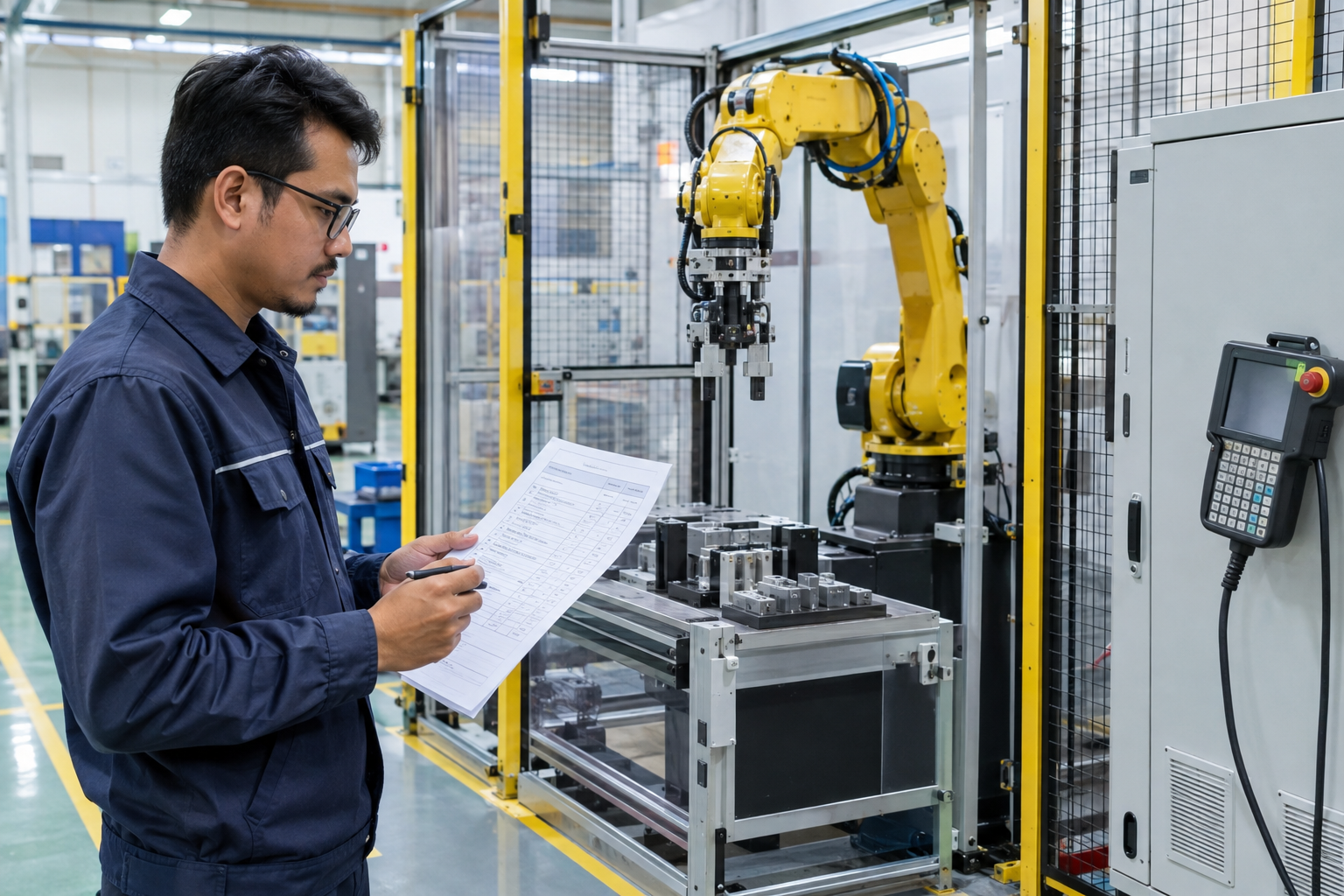
- Request application validation: ask for a cycle-time demonstration, tooling concept, interface plan and safety concept using representative parts.
- Agree acceptance criteria: define what will be tested during factory acceptance, site acceptance, commissioning and handover.
Frequently Asked Questions
Can a cobot replace an industrial robot?
A cobot can replace a conventional robot in some flexible or shared-workspace applications, but it is not an automatic substitute when the task requires greater speed, payload, reach or continuous throughput than the proposed cobot workcell can deliver. Validate the complete application rather than comparing labels.
Are cobots cheaper than industrial robots?
Cobots are not universally cheaper. Compare the complete cell and its required output, including tooling, fixtures, sensors, safety controls, integration, programming, training, maintenance and downtime. The result depends on the application assumptions.
What is the first information to give an integrator?
The first information should be the actual workpiece, process sequence, target cycle time, payload, shift pattern, product variation, available space and operator interaction requirements. These inputs allow the proposed robot type and workcell to be assessed against the real task.
Next step: request an application-based robot assessment
Prepare representative parts or drawings, a process video, the target cycle time, payload information, shift pattern, current bottleneck and layout constraints. Then contact Chin Tech to discuss an application-based comparison using the same throughput, safety, integration and acceptance criteria. The proposed solution and safeguarding approach should be confirmed against your actual process.