
When you’re shortlisting an automation company in penang, you’re choosing an engineering partner that will affect cycle time, quality, safety, traceability, and maintenance workload for years. Two proposals may look similar on paper, yet outcomes can differ based on integration depth, documentation, commissioning discipline, and how fast support arrives when production is down.
This practical guide is for factory managers and project engineers evaluating local integrators in Penang. Use it to verify capabilities, certifications, execution discipline, and site support—by asking the right questions and requesting the right evidence.
1) Start with fit: define the automation scope the same way
Align internally on a scope an integrator can price and deliver consistently. Most delays come from unclear boundaries: who supplies fixtures, who owns safety validation, what data must be logged, and what “acceptance” means.
Key inputs to standardise before vendor evaluation
- Process objective: target cycle time, quality/inspection needs, yield risks, and main causes of scrap or rework.
- Part and variant complexity: SKU count, tolerances, changeover frequency, and expected future variants.
- Line constraints: footprint, access, ESD/cleanroom needs (if any), noise limits, and safety separation.
- Interfaces: upstream/downstream machines, conveyors/feeders, soldering/test/vision stations, and MES/traceability requirements.
- Acceptance approach: FAT/SAT tests, sample sizes, and required data capture.
With a consistent scope, you can compare how each supplier designs around real constraints—not just how well they present robotics.
2) Evaluate core capabilities: integration depth matters more than brands
Robot and sensor brands are common; system integration capability is not. Validate whether the team can engineer the full workcell: mechanics, controls, safety, vision, end-effectors, and process tuning. Ask for proof aligned to your application, not generic brochures.
Capabilities to validate (with examples of evidence)
- System design and risk reduction: layout drawings, reach studies, cycle-time breakdowns, maintainability access, and failure-mode thinking.
- Controls engineering: PLC/HMI standards, electrical schematics, panel build quality, alarm strategy, and troubleshooting flow.
- Robotic applications experience: pick-and-place, machine tending, assembly, polishing/grinding (force control), welding, palletizing, and high-mix changeovers.
- Machine vision & inspection: lighting/lens specification, triggering, calibration method, and reject/rework logic for a robotic vision inspection system.
- End-effectors & tooling: vacuum/electric grippers, compliance mechanisms, force/torque sensing, and quick-change options for variants.
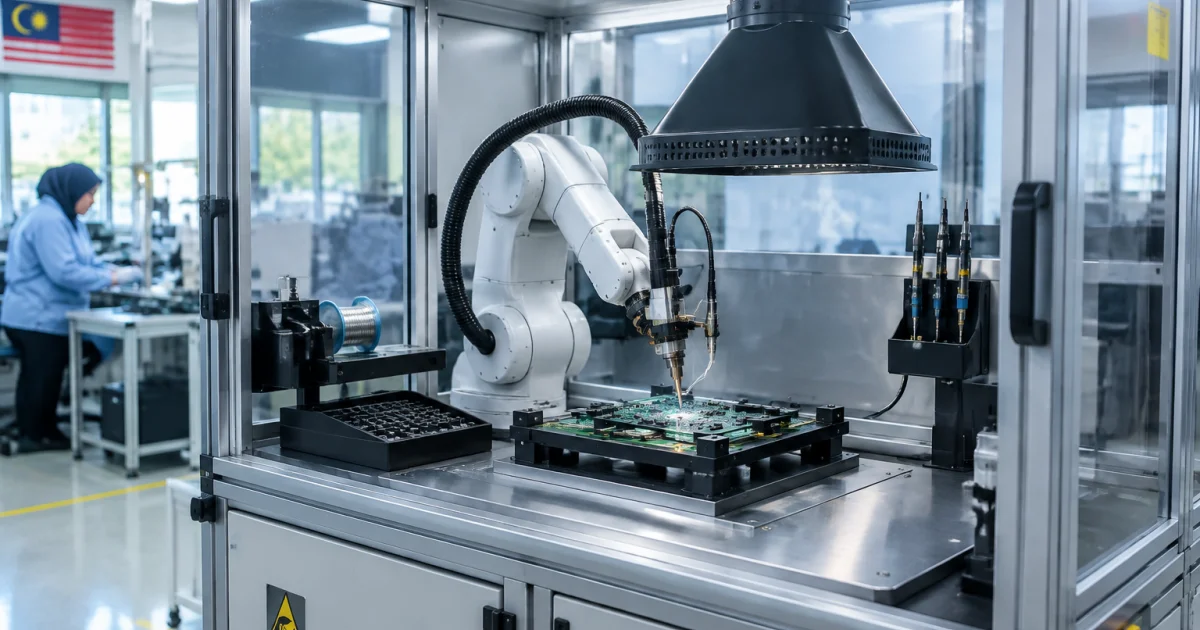
- Process-specific know-how: for electronics, evidence of robotic soldering/auto soldering know-how (tip management, flux control, thermal consistency, stable fixture design).
- Internal logistics automation: if in scope, AMR basics such as mapping, traffic rules, docking, and integration with conveyors or storage.
Prioritise design rationale. A supplier who can explain why a specific gripper, sensor, or vision setup was chosen is more likely to deliver stable performance than one relying on catalogue selections.
3) Certifications and quality systems: what to check beyond a logo
Certifications don’t guarantee results, but they can indicate repeatable processes—especially for documentation and change control. Use them to reduce risk, not as a checkbox.
ISO 9001:2015 and what it should mean for your project
If the integrator is ISO 9001:2015 certified, verify how that shows up in day-to-day project control:
- Document control: revision tracking for drawings, PLC code backups, manuals, and SOPs.
- Nonconformance handling: how FAT/SAT issues are logged, assigned, and verified closed.
- Supplier management: how critical components (cameras, safety devices, sensors, actuators) are qualified and lead times managed.
- Change management: how scope/cost/timeline impacts are recorded and approved when requirements shift.
Confirm traceability for software versions and electrical drawings so your maintenance team can support the installed system confidently.
Safety competence (even if you manage the final sign-off)
Safety is typically shared between your EHS requirements and the integrator’s machine design. Ask how they define safety architecture (guarding, interlocks, safety PLC/relays, E-stops, safe stop/speed) and how risk assessment and validation are built into the project plan.
If your system uses area monitoring or navigation sensing, ask what safety sensors they integrate and how they validate configuration and zoning during commissioning.
4) Site support and response readiness: the difference between a demo and a production line
Many projects pass acceptance but struggle later due to training gaps, unclear manuals, or slow support. In a real factory, ramp-up and uptime depend on how the partner supports commissioning, stabilisation, and long-term troubleshooting.
Support checkpoints to include in your evaluation
- Commissioning plan: on-site days, roles present (controls/mechanical/vision), and daily handover method.
- Spare parts strategy: recommended spares list, critical components, and local availability vs. special order.
- Training: operator and maintenance training scope plus supporting materials (quick guides, fault trees, parameter lists).
- Remote support readiness: ability to use logs, backups, and images quickly within your IT/security rules.
- Post-SAT support window: escalation path and response process during ramp-up when production is impacted.
Ask for a real example of diagnosing a line stop (sensor fault, vision misread): what data they requested, how they isolated the root cause, and how they prevented recurrence.
5) Project execution evidence: documentation, FAT/SAT discipline, and clarity
When multiple vendors claim they can “do everything,” insist on deliverables. Execution quality is visible in documentation, testing structure, and how assumptions are managed. This separates a basic machine builder from a dependable automation system integrator malaysia manufacturers can scale with.
Must-have deliverables (request samples, not promises)
- Proposal clarity: scope boundaries, inclusions/exclusions, assumptions, and constraints.
- Engineering package: layout, mechanical drawings, electrical schematics, I/O list, pneumatic diagram (if used), and safety circuit details.
- Software documentation: PLC/HMI backup procedure, key parameter list, and an alarm list with causes and actions.
- FAT checklist: structured tests (cycle tests, fault simulations, safety checks, and required data capture such as inspection records or barcode reads).
- SAT checklist: site integration tests, changeover verification, and clear handover criteria.
- Maintenance pack: lubrication points, wear parts, intervals, and troubleshooting guide.
For soldering automation, request process validation: how solder quality is verified, what parameters are locked, and how the system prevents gradual operator-driven drift. For inspection, ask how false rejects/false accepts are measured and tuned without turning the system into manual sorting.
Look for engineering maturity during Q&A
Listen for practical specifics: cable routing and labeling, noise isolation, access panels for maintenance, fixture repeatability, and how alarms guide technicians to the next action. These details often predict commissioning speed and long-term stability.
6) Shortlist using a weighted scorecard (and the right questions)
Reduce subjectivity by using a weighted scorecard matched to your risk profile. For high-mix electronics, changeover and vision robustness may matter most; for palletizing or internal logistics, throughput stability and traffic management may dominate.
| Evaluation area | What “good” looks like | Evidence to request |
|---|---|---|
| Application capability | Proven designs for your process and constraints | Reference architectures, sample layouts, similar use cases |
| Engineering & documentation | Clear drawings, structured alarms, backup discipline | Sample schematics, FAT/SAT templates, manual excerpts |
| Safety approach | Safety designed-in, validated and documented | Safety concept, risk assessment approach, validation checklist |
| Inspection & vision | Robust lighting, calibration, and reject handling | Vision test plan, sample images, tuning method |
| Support & ramp-up | Defined response process and on-site competence | Support plan, spares list, training outline |
| Project management | Milestones, clear acceptance criteria, change control | Project timeline, RACI, change request process |
Use the same questions for every vendor. When answers differ, it’s usually due to hidden assumptions—capture them in writing before issuing a PO.
Questions that quickly reveal suitability
- What are the top three technical risks in our scope, and how will you mitigate them?
- Which parts will you design/build in-house, and what will be outsourced?
- How will you structure FAT so problems are found before delivery?
- What is your plan for spares, training, and handover so our team is self-sufficient?
- If the vision system drifts (lighting/reflections/contamination), what is the tuning and validation workflow?
Conclusion: choose the partner you can run with, not just buy from
Evaluating a Penang automation partner is about lowering production risk. The best choice is rarely the flashiest demo; it’s the team that can prove integration depth, disciplined execution, and dependable support with clear deliverables.
Prioritise evidence: sample documentation, structured FAT/SAT, safety competence, and a support model that fits your uptime requirements. If your scope includes robotic soldering, inspection, or internal logistics, ensure the partner can explain how quality is validated and kept stable after ramp-up.
For additional background while you compare vendors, you may find these useful: a welding robotic arm project example and a product reference for line guidance and grid localization solutions.
Frequently Asked Questions
What should I ask an automation company during a Penang site visit?
Ask to walk through their project workflow end-to-end: how they gather requirements, produce drawings, manage changes, run FAT/SAT, and support ramp-up. Request examples of electrical schematics, alarm lists, and a FAT checklist. Also ask who will actually be on-site for commissioning (controls/vision/mechanical) and how escalation works when production is impacted.
Is ISO 9001:2015 important when selecting an automation partner?
It’s useful as a signal of process discipline, especially for document control, change management, and corrective action handling. Treat it as a starting point: ask how revisions are managed for drawings and PLC/HMI backups, how FAT/SAT issues are logged and closed, and how changes are approved so your installed system remains traceable and maintainable.
How do I evaluate machine vision and inspection capability before buying?
Ask for a proposed inspection concept showing lighting, camera placement, triggering, calibration, and reject handling. The supplier should explain how they will measure and tune false rejects/false accepts and how they will manage real factory variation (glare, dust, part color shifts). For higher-risk applications, request a structured vision test plan as part of FAT.
What’s the difference between a machine builder and an automation system integrator?
A machine builder may focus on delivering a standalone machine, while an automation system integrator typically designs the full system including interfaces to your upstream/downstream equipment, safety architecture, controls standards, traceability or data integration (when required), and long-term support. For multi-station lines, mixed equipment, or vision-driven inspection, integrator capability often reduces hidden commissioning risk.
How can I compare quotes fairly between automation vendors?
Standardise your scope and acceptance criteria, then require each vendor to list assumptions and exclusions. Compare deliverables (drawings, software backups, manuals), FAT/SAT structure, support coverage, and spares strategy—not only headline cycle time and price. Using a weighted scorecard helps ensure you select based on operational risk and long-term maintainability.
Need a reliable automation partner in Penang? Talk to Chin Tech
If you’re shortlisting integrators for a new cell or line upgrade, Chin Tech can help you validate feasibility, clarify scope, and design an automation solution built for production realities—covering cobots, robotic soldering systems, AMRs, machine vision & inspection, end-effectors, and full system integration. With ISO 9001:2015 processes, local engineering support in Penang, and extensive deployment experience, our team focuses on stable commissioning, clear documentation, and long-term site support.