

As Malaysian industries continue to adopt automation, the demand for reliable sensing technology has grown rapidly. From smart warehouses to advanced manufacturing lines, businesses are under pressure to improve efficiency while maintaining strict safety standards.
This is where SICK sensors in Malaysia play a critical role, providing accurate spatial awareness that enables machines to “see” and respond in real time.
What Makes 3D LiDAR Different from Traditional Sensors
Unlike conventional sensors that detect objects in a single plane, 3D LiDAR sensors capture depth, distance, and position simultaneously. This allows for a complete understanding of the environment, making them ideal for dynamic and complex industrial settings.
In practical terms, this means:
- Detecting obstacles in multiple layers
- Monitoring movement in real time
- Enabling safer interaction between humans and machines
For industries in Malaysia where space, speed, and safety must be balanced, this added dimension of data is a major advantage.
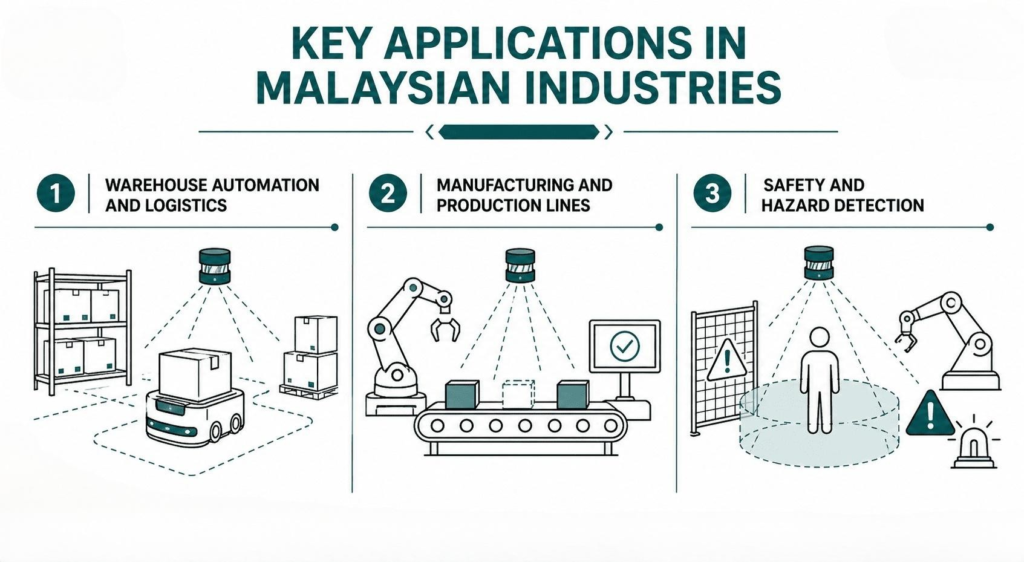
Key Applications in Malaysian Industries
1. Warehouse Automation and Logistics
In modern warehouses, automated guided vehicles (AGVs) and autonomous mobile robots (AMRs) rely on accurate navigation. SICK 3D LiDAR sensors help these systems:
- Avoid collisions
- Navigate efficiently through changing layouts
- Operate safely alongside human workers
This is especially valuable as e-commerce growth in Malaysia continues to drive demand for smarter logistics operations.
2. Manufacturing and Production Lines
On factory floors, precision and consistency are critical. LiDAR sensors can:
- Monitor object positioning
- Detect irregularities or obstructions
- Support robotic arms in complex tasks
This improves both product quality and operational efficiency without slowing down production.
3. Safety and Hazard Detection
Workplace safety is a top priority, particularly in high-risk environments. SICK sensors enhance safety by:
- Creating virtual safety zones
- Detecting human presence in restricted areas
- Triggering automatic system responses when risks are detected
This reduces the likelihood of accidents while ensuring compliance with safety standards.
Why SICK 3D LiDAR Sensors Stand Out
SICK is known globally for its industrial sensing technology, and its 3D LiDAR solutions are designed specifically for demanding environments.
Key advantages include:
- High accuracy and reliable detection
- Robust performance in challenging conditions
- Flexibility for integration into different automation systems
For Malaysian industries dealing with humidity, dust, and continuous operation, durability and consistency are essential—and this is where SICK sensors perform well.
Important Factors to Consider Before Implementation
Choosing the right SICK sensor in Malaysia involves more than just specifications. Key considerations include:
- Range and field of view: Ensure coverage matches your application
- Environment conditions: Consider dust, lighting, and temperature
- System integration: Compatibility with existing automation systems
- Safety requirements: Align with your operational risk levels
A well-planned setup ensures the sensor delivers accurate and reliable data over time.

