
End-effector selection looks simple on a slide: “vacuum for flat parts, mechanical for everything else.” On a real line, the wrong choice shows up as drops, scuffs, slow cycles from conservative motion, and constant operator tweaks.
This article takes a practical view: if you’re choosing between a vacuum gripper robot and a mechanical gripper for packaging, sheets, and smooth parts, decide by failure modes first (what can go wrong), then tune for speed (what can go fast) and maintainability (what’s easy to live with).
Below are the situations where suction is the clear winner, where it’s the wrong tool, and how to run trials that survive real variation—dust, humidity, warp, film, mis-stacks, and handling damage.
The real difference: vacuum fails “suddenly,” mechanical fails “gradually”
Both can be reliable, but they fail differently—and that should drive your risk strategy.
Vacuum gripping tends to fail suddenly. A small leak, porous material, a clogged filter, or a missed seal can drop holding force quickly. Without sensors, the robot may not “know” until the part shifts or falls.
Mechanical gripping tends to fail gradually. As friction, thickness, or part position drifts, you’ll often see slip, misalignment, or cosmetic marks before total failure—especially if you have part-present sensing and some compliance.
Rule of thumb: if a single drop is a serious safety or damage risk, lean mechanical (or vacuum with redundancy and strong detection). If gentle handling and fast acquisition matter most—and the part seals reliably—vacuum is compelling.
When suction wins: the vacuum advantages that matter on a line
Vacuum doesn’t win just because “the part is flat.” It wins when its strengths match your real constraints.
1) Broad contact with low local stress
For thin films, labels, flexible packaging, blister trays, and cosmetic surfaces, mechanical jaws can create pressure points and marks. Vacuum spreads the load and can be tuned with cup size, lip geometry, or foam to reduce imprinting.
2) Fast pick from uncertain position (within a zone)
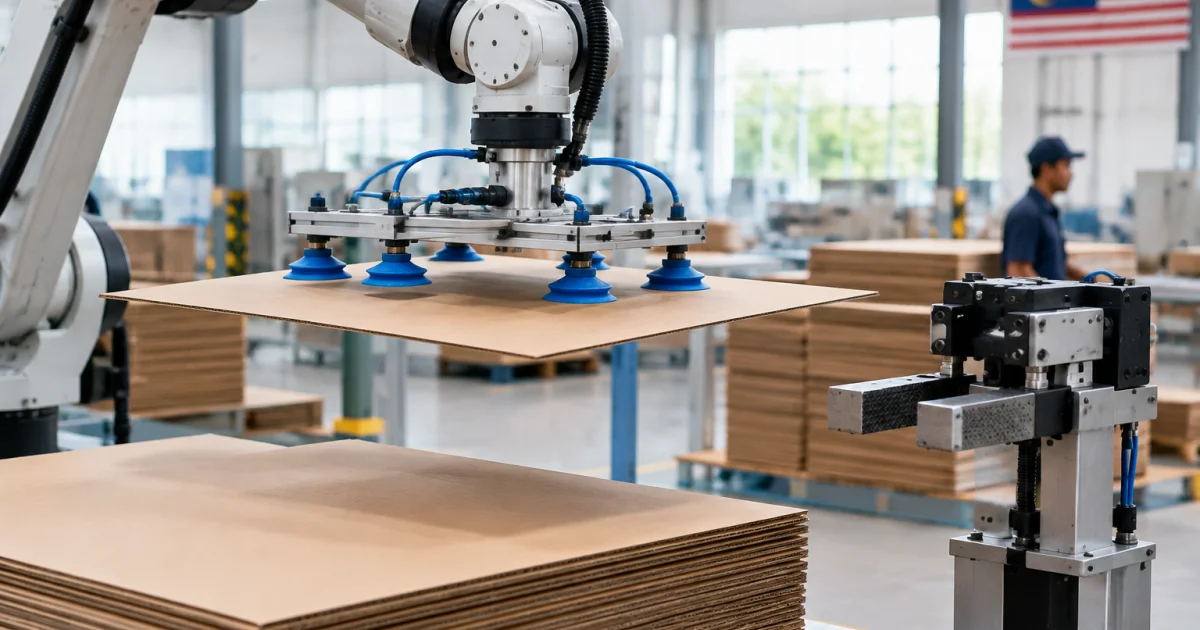
If parts arrive in a repeatable area but not a precise pose (top-pick from stacks, sheet feeding, depalletizing cartons), suction can “land-and-seal” quickly. A mechanical gripper usually needs a consistent edge or feature to clamp.
3) No safe mechanical feature to grab
Many packaging and sheet scenarios have no flange, hole, or stable edge you can pinch without damage. If adding a feature isn’t possible, vacuum is often the least invasive option.
4) High mix / frequent changeovers
Vacuum arrays are often modular: move cups, swap plates, and cover a range of SKUs with less custom jaw tooling. This aligns well with a collaborative robot gripper approach where redeployment speed matters.
5) Simple “pick verification” (if you use it)
A vacuum pressure switch can give fast feedback: seal achieved or not. Use it for confirmation, retries, and rejects. Many “vacuum is unreliable” complaints come from running open-loop.
When suction fails: the failure modes engineers underestimate
Vacuum problems are often blamed on “bad cups,” but the root cause is usually the part or environment. Watch for these issues in trials.
1) Porosity and micro-leaks
Paperboard, corrugated, foam, textured, or fibrous surfaces can leak faster than the vacuum source can maintain. You can sometimes compensate with larger cups, foam seals, higher-flow ejectors, or multi-cup distribution—but air use, noise, and sensitivity to drift often increase.
2) Warp and inconsistent flatness
Cartons and sheets that are “flat” in CAD can arrive curled, bowed, or with lifted corners. A cup may seal on a high spot, but the part can pivot under acceleration. Rotation or “swimming” in transit is often a rigidity/flatness problem, not just vacuum level.
3) Dust, oil mist, and maintenance reality
Dust clogs filters and fouls cup lips; residues reduce sealing consistency. Plan for accessible filters, spare cups, and a quick way to verify vacuum health (sensor thresholds, leak checks).
4) High acceleration, vibration, long reach
Static holding force isn’t the whole story. Dynamic loads can peel a cup or break a marginal seal during aggressive acceleration, long-reach vibration, or abrupt stops. If you need speed, increase contact area (more/larger cups), improve vacuum flow, add guides, or use a mechanical backup.
5) Thin bags and “double picking”
Vacuum commonly picks two layers (two bags, two sheets, sheet plus separator). Fixes are usually separation and sensing (air knives, feeders, double-sheet detection) rather than “more vacuum.” If downstream can’t detect doubles, consider a mechanical geometry-based pick.
6) Safety and drop tolerance
In collaborative environments, a drop may be unacceptable. Vacuum can be safe, but design for safe failure: pick verification, pressure decay monitoring, controlled motion when vacuum is low, and appropriate guarding/risk assessment.
Where mechanical grippers shine (and where they cause headaches)
Mechanical grippers feel “certain” because they physically retain the part, but they introduce clamp-force and alignment risks—especially on smooth or cosmetic surfaces.
Mechanical wins when:
- You need positive retention during fast motion, long reach, or vibration.
- The part is porous, dusty, oily, or irregular where sealing is unreliable.
- You can grab a stable feature (edge, flange, hole, rib) without cosmetic damage.
- You must control orientation tightly and prevent rotation with asymmetric payloads.
Mechanical causes problems when:
- Surface marking matters (printed cartons, polished parts, films).
- Thickness varies and the gripper lacks compliance or force control.
- Alignment is inconsistent, causing jaw crashes or missed picks.
- Changeovers are frequent and jaw tooling must be swapped often.
In cobot cells, prioritize controllable force, compliance, and reliable part detection over maximum clamp force.
A practical selection checklist (how I’d decide in a commissioning meeting)
Don’t start with “what others do.” Start with constraints and measurable acceptance criteria you can test at FAT/SAT.
Step 1: Define the “drop and damage” cost
- Is a drop allowed at all (safety, contamination, scrap)?
- What cosmetic mark rate is acceptable?
- Is there a catch tray/contained area that reduces consequences?
If the cost of a rare drop is extremely high, favor mechanical, vacuum redundancy (multiple circuits), or a hybrid.
Step 2: Characterize surface and variability (design for the worst 5%)
- Surface: glossy, textured, porous, dusty, oily, wet?
- Flatness: curl, warp, dome, inconsistent stack height?
- Temperature: does the material soften or deform?
Step 3: Map motion dynamics vs cycle time
- Peak accel/decel immediately after pick.
- Reach and robot posture (vibration risk).
- Orientation changes while carrying (tilt/rotation).
Vacuum can be extremely fast only when it remains stable under dynamics. If you must derate speed to avoid peel-off, you’re paying a hidden cycle-time penalty.
Step 4: Decide sensing and logic (not optional)
- Vacuum: pressure sensor for pick confirmation, decay monitoring, retries.
- Mechanical: part-present sensing, jaw position feedback (if available), force/current monitoring.
If you’re using vision for orientation/presence/defects, integrate it into handling decisions. Vision inspection machines can also reduce uncertainty by confirming single-sheet pickup and correct placement before the next step proceeds.
Step 5: Utilities, noise, and maintenance
- Vacuum generation: venturi vs pump, air consumption, noise.
- Filters and cup wear; spare parts and change time.
- Mechanical pads and wear surfaces; alignment and rework.
A tool that is slightly faster but needs daily fiddling usually loses in OEE. Choose what your maintenance team can support.
Hybrid and “better than either” options (often the best production answer)
Vacuum vs mechanical isn’t always either/or. In packaging and sheet handling, a hybrid end-effector is often the most robust: use suction to acquire, then add mechanical support to survive dynamics.
- Vacuum + side guides to prevent rotation and reduce peel forces.
- Vacuum + light clamp for high acceleration moves.
- Multi-zone vacuum so one leaky cup doesn’t collapse the whole system.
- Compliant suction arrays (springs/foam) to handle warp and stack variation.
Also think at the cell level: if the handling step feeds inspection, a robotic vision inspection system can reduce the need to “over-grip” by catching mis-picks early. Treat gripper + sensing + inspection as one system.
Examples by application: quick guidance you can challenge during trials
- Flat carton blanks / sheets: vacuum often wins for gentle, fast top-pick; watch dust and curl; add sensing and guides.
- Sealed plastic trays: vacuum works well on smooth lids; mechanical may mark/crack; add double-pick detection where relevant.
- Porous molded fiber / uncoated paperboard: mechanical or hybrid often wins unless you accept higher-flow vacuum and tight maintenance.
- Oily stamped metal sheets: sealing can be inconsistent; mechanical edge grip (or magnetic options when applicable) is often steadier.
- Electronics near soldering: residues/heat affect cups; use resistant materials and cleaning plans. If feeding an auto soldering machine, placement stability often matters more than raw speed.
Validate with real samples: worst-case contamination, real dust, and real operator stack quality—not ideal lab pieces.
Useful next reads (product examples for faster evaluation)
- OnRobot VG10 Vacuum Gripper for flexible suction handling concepts.
- OnRobot RG2-FT Smart Gripper if you need force feedback to reduce crushing/marking risk.
- OnRobot RG6 Collaborative Gripper for a robust mechanical option across larger part ranges.
- OnRobot Gecko Gripper as an alternative adhesion approach for certain flat materials.
- OnRobot RG2 Gripper for general-purpose mechanical gripping in compact cells.
Conclusion: choose the failure mode you can control
Vacuum is hard to beat when you need gentle, flexible pickup on smooth, sealable surfaces—and when you add sensing plus maintenance discipline to prevent sudden drops. Mechanical gripping is often the safer choice when sealing is uncertain, dynamics are aggressive, or the cost of a drop is unacceptable—provided you control force and avoid marking.
Decide using worst-case parts and your tolerance for abrupt failure. Then design the end-effector, sensing, and inspection strategy together to keep cycle time fast and production stable.
Frequently Asked Questions
How do I know if a vacuum gripper will be reliable on my cartons or sheets?
Run trials with worst-case samples (dusty, curled, slightly warped, and from the bottom of a real stack). Add a vacuum sensor for pick confirmation and monitor pressure decay during transport. If you need to slow the robot too much to prevent slip or peel-off, consider a larger suction area, multi-zone vacuum, guides, or a hybrid clamp.
What’s the biggest hidden cost of vacuum gripping in production?
Maintenance and process drift. Filters clog, cup lips wear, dust builds up, and sealing performance changes over time. If you don’t plan accessible filters, spares, and a routine check method (sensor thresholds, leak tests), you can end up chasing intermittent drops and micro-shifts that look like “random” faults.
Can a collaborative robot gripper use vacuum safely around people?
Yes, but it needs safety-minded design: pick verification, pressure monitoring, controlled speed when vacuum is low, and a risk assessment for the specific payload and motion. In many cobot cells, adding part-present sensing and defining a safe drop zone (or catch tray) is as important as the gripper choice itself.
When is a mechanical gripper a better choice than suction for smooth parts?
When smooth parts don’t seal consistently (oil mist, texture, contamination), when accelerations are high, or when a drop is unacceptable. Mechanical gripping also helps when you must control orientation tightly. Use suitable jaw pads, compliance, and force control to avoid marking or crushing.
Do you provide robot integration services for ASEAN manufacturers who need end-effector selection and testing?
Yes. Chin Tech supports manufacturers in Malaysia and across the region with end-to-end automation system integration—from concept and end-effector selection to robot programming, machine vision/inspection integration, testing, and commissioning. The goal is to validate gripping on real parts and build a stable process, not just install hardware.
Need a gripper that won’t become your line’s weakest link? Talk to Chin Tech
If you’re deciding between vacuum and mechanical gripping for packaging, sheets, or smooth parts, Chin Tech can help you evaluate the real failure modes, test with your samples, and design an end-effector and sensing strategy that holds up in production.
As an end-to-end automation integrator based in Penang, we combine robots, robotic end-effectors & grippers, machine vision and inspection, and commissioning support to deliver a stable, maintainable solution—not just a tool on a flange.