
How to Choose a Mobile Manipulator (AMR + Robot Arm) for Malaysian Factories
Learn when a mobile manipulator (AMR + robot arm) suits your factory, what technical and safety requirements to assess, and how to compare proposals.
How to Choose a Mobile Manipulator (AMR + Robot Arm) for Malaysian Factories
Choosing a mobile manipulator in Malaysia starts with the factory process, not a robot model. Define the travel route, pickup and drop-off points, handling task, payload, reach, docking accuracy, cycle-time target and operator interaction. Then ask suppliers to show how the complete mobile base, robotic arm, end-effector and control system will meet those requirements. Treat an early model shortlist as provisional until the application and safety arrangements are validated for the actual site.
For factories in Penang, Kuala Lumpur, Johor Bahru and elsewhere in Malaysia, the same principle applies: compare the complete workflow and operating environment. A mobile manipulator may be considered for moving tools, components and other production materials between stations, but suitability depends on the specific load, route, task and required safeguards.
Start with the process: when does a factory need a mobile manipulator?
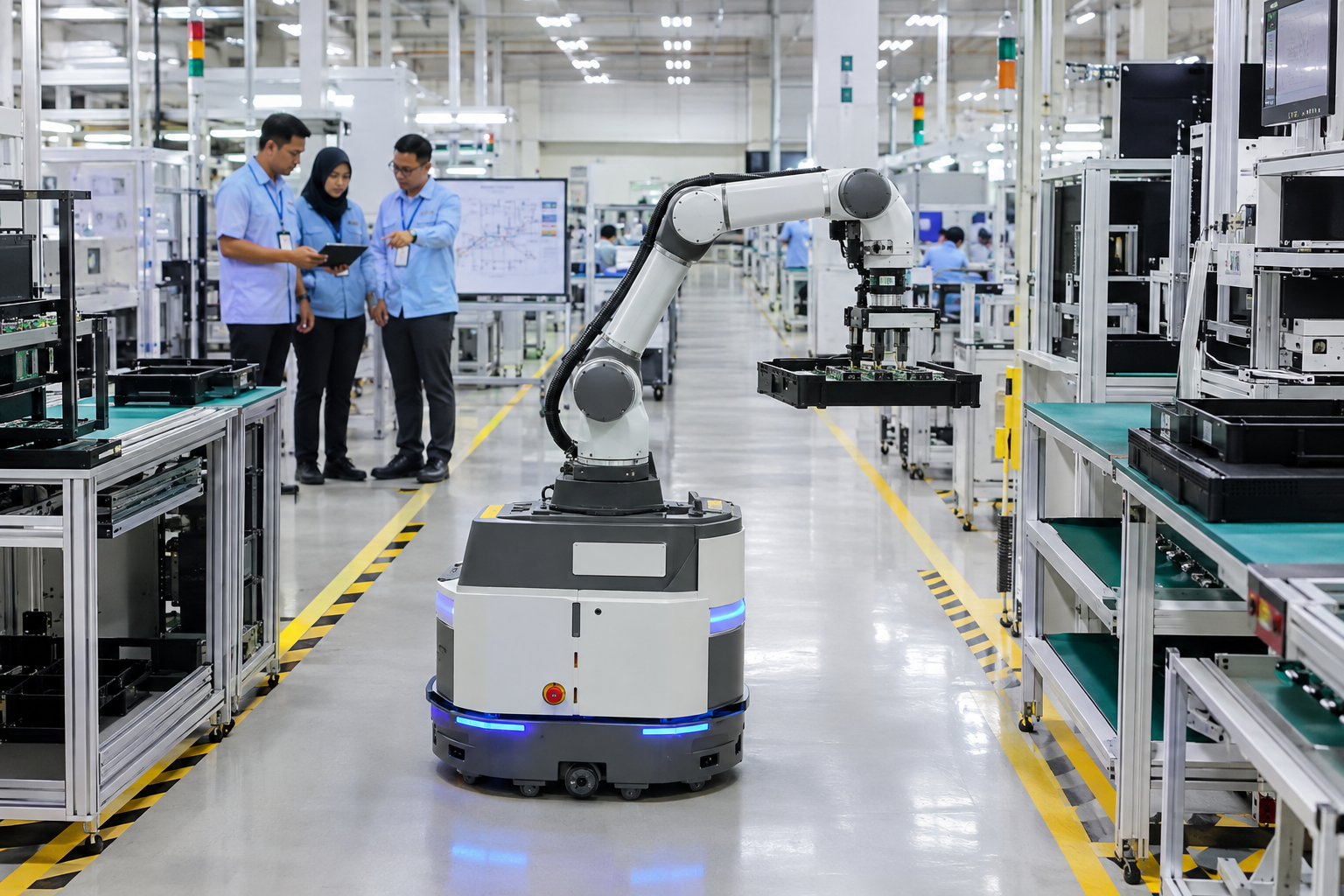
A mobile manipulator combines a mobile robotic platform with a robotic arm and end-effector. Depending on the system, the base may use autonomous navigation, commonly associated with autonomous mobile robots (AMRs), or predefined guidance methods used by traditional automated guided vehicles (AGVs). The complete solution must coordinate travel, positioning, manipulation, machine interfaces and safety controls. Its value lies in combining mobility and a useful handling task within one production workflow.
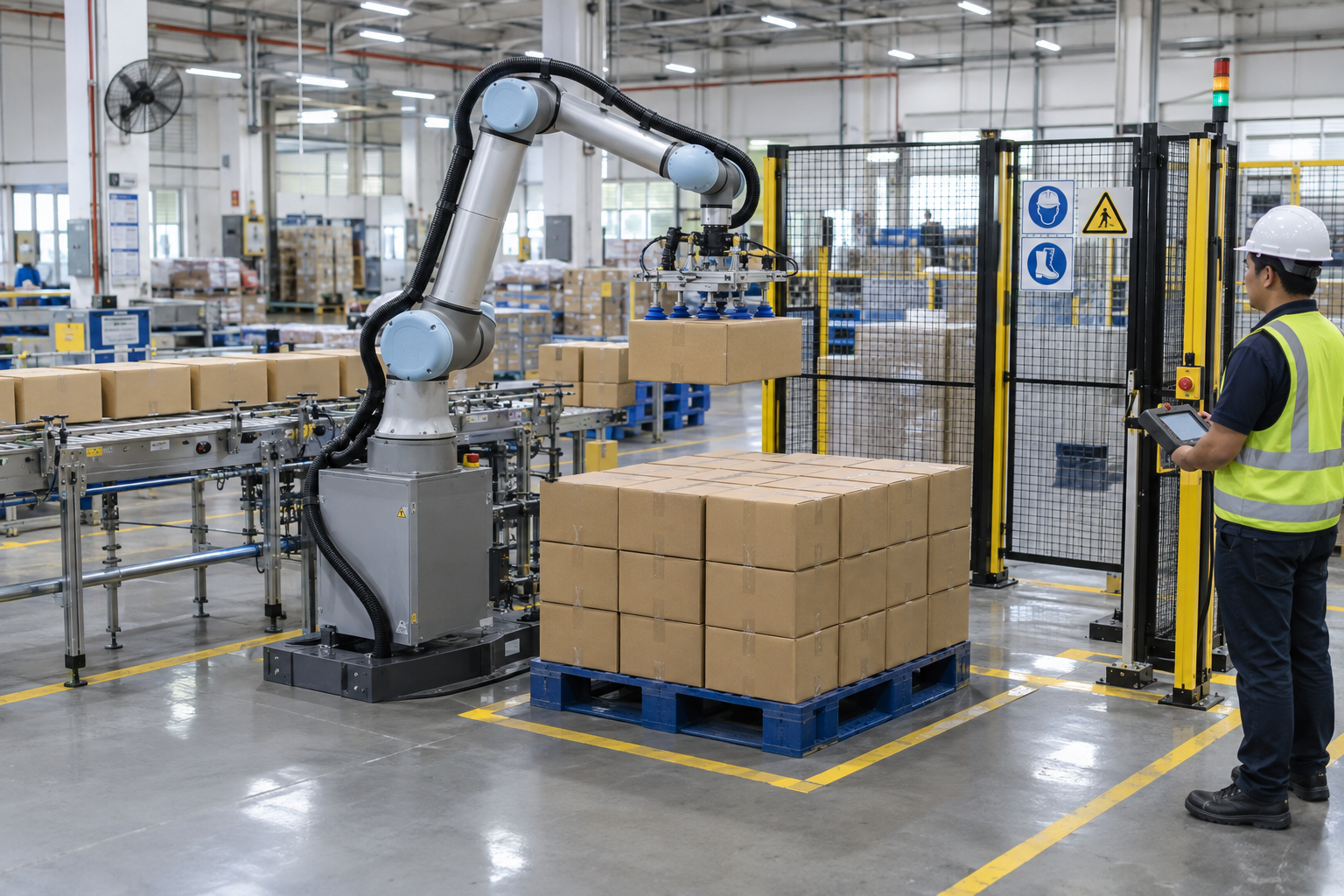
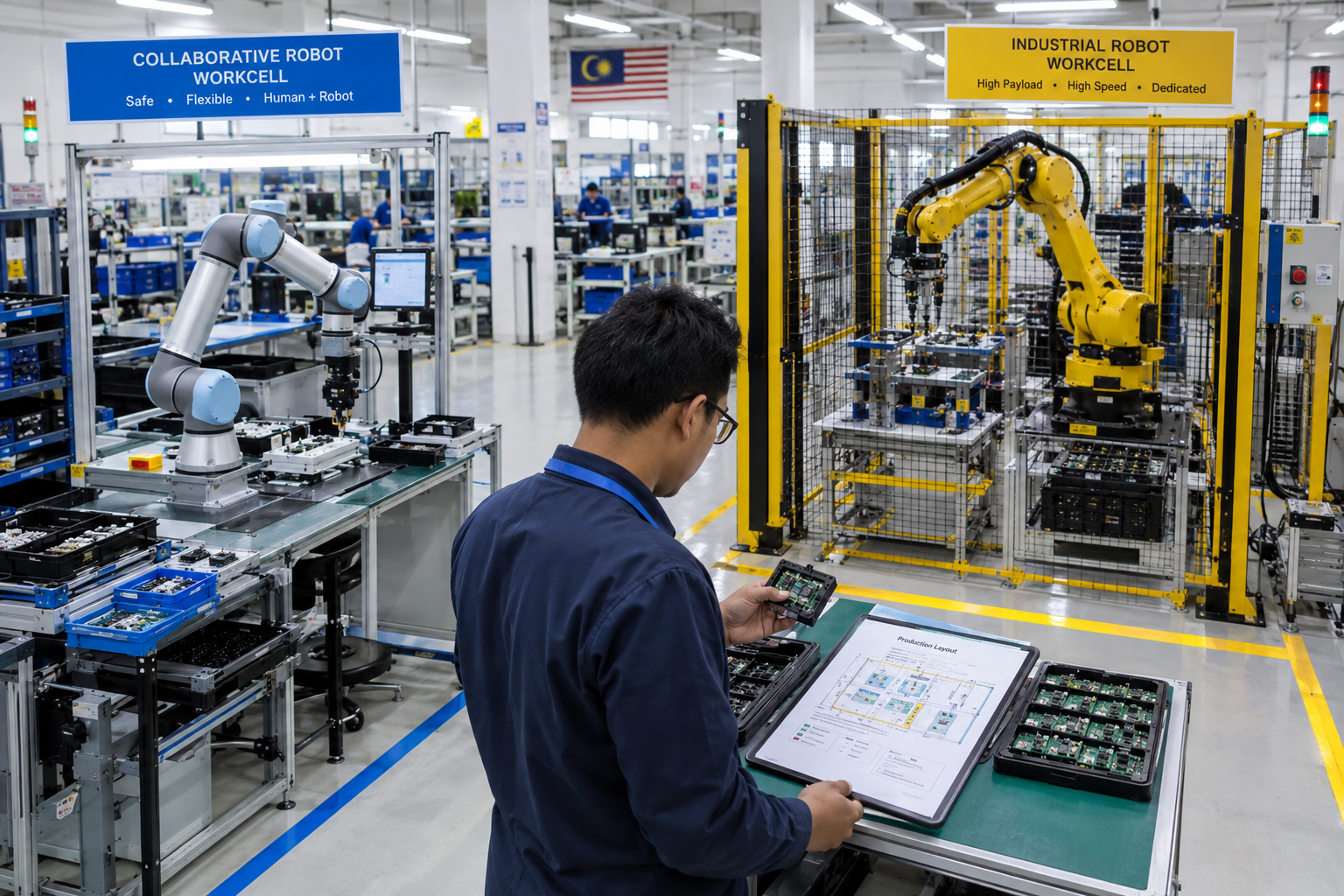
As a planning hypothesis, a mobile manipulator may be worth evaluating when one arm needs to serve multiple locations, the pickup or drop-off point changes, or the layout requires more flexibility than a fixed cell. It may also be relevant to repeatable internal material movement, machine tending or part transfer between workstations. These are not universal selection rules: compare the route, task, payload, production target and operating zone with a fixed robot, standalone AMR or other architecture, then ask the supplier and a qualified engineer to validate throughput, integration, safety and maintenance for the specific application. If one high-duty-cycle operation stays at one station, include a fixed robot or dedicated cell in that comparison rather than assuming mobility is beneficial.
Before requesting a detailed quotation, describe one complete route: where the system collects the item, how it travels, where it docks, what the arm does, and where it returns. A demonstration of autonomous localisation, grasping and precise placement is not proof that the system will perform the same task reliably in your production environment.
Convert the production task into a technical specification
Suppliers need measured process information, not only a general request for an “AMR robot arm”. Record the part, fixture, gripper and tool mass at the point of manipulation. Include part dimensions, centre of gravity, required reach, placement accuracy and whether the base must carry, pull or both.
When evaluating a mobile manipulator, clarify whether published load specifications refer to the mobile base, towing capacity or the robotic arm. These figures should be assessed separately rather than assumed to represent the complete system’s handling capability. Before selecting equipment, request model-specific technical documentation and ask the supplier to confirm the allowable base load, robotic-arm payload including tooling, reach, stability, braking performance and operating speed under the intended application and route conditions.
Map every pickup and drop-off station, docking or handoff point, travel path, navigation condition and arm movement. Then document product variants, expected route changes, workstation changes, changeover frequency and the acceptable reconfiguration effort. “Flexible” should become a measurable requirement, such as the time or steps allowed to add a route or change a part presentation.
Make setup and reconfiguration part of the specification rather than treating them as vague benefits. A simple setup should mean that the supplier can explain the required site preparation, route mapping, workstation handoff and operator training in practical steps. A quick setup should be tied to an agreed project milestone or acceptance activity, not assumed from a short demonstration. Ask how long it takes to add a route, change a part presentation or move a workstation interface, and who performs that work.
Reconfigurable does not mean every change is automatic or cost-free. Confirm which changes operators can make, which require integrator support and whether new grippers, fixtures, software changes or safety reviews are needed. Record these limits in the URS so flexibility can be compared with the simpler setup of a fixed robot or standalone AMR.
Information to collect before supplier discussions
- Floor plan showing routes, crossings, restricted areas, doors, aisles and workstation interfaces.
- Part samples or drawings, fixture details, gripper access and maximum payload at the wrist.
- Target cycle sequence, production volume, shift pattern and required availability.
- Docking locations, charging arrangements, floor conditions, ramps, obstacles and traffic patterns.
- Required placement accuracy, fault recovery behaviour and acceptable manual intervention.
Check safety, operating zones and compliance responsibilities
Assess the complete installed system rather than the mobile base or arm in isolation. Consider the vehicle, navigation and control system, arm, end-effector, workpiece, power supply, connected machines and intended operating zone. Moving the arm between workstations changes where people and other equipment may encounter the system, so the risk assessment must reflect the actual route and handling task.
Document people and vehicle traffic, crossings, restricted areas, floor and route conditions, docking points, obstacles, charging arrangements and foreseeable hazards. Include liquids, uneven surfaces and changing work areas where relevant. The operating-zone review should explain how the system detects obstacles, stops, restarts after an interruption and responds when a person enters the route.
ISO 3691-4:2023 provides an international reference for safety requirements and verification concerning driverless industrial trucks and their systems, including applicable AGV and AMR operating environments. However, citing this standard does not establish that a particular mobile manipulator—including its mobile base, robotic arm, end-effector, tooling and interactions with people or other equipment—has been fully assessed or complies with Malaysian law. For a specific installation, the supplier, integrator, qualified safety professional and factory’s responsible personnel should identify applicable requirements and document a site- and application-specific risk assessment, safeguarding measures and validation plan.
Compare the architectures before comparing suppliers
Use the same process requirements to compare a mobile manipulator with a standalone AMR and a fixed robot. The preferred option is the one that meets the mapped route, manipulation task, cycle, payload, accuracy, safety and changeover requirements with the fewest unresolved site assumptions.
| Architecture | Best fit | Main trade-off | Questions to verify |
|---|---|---|---|
| Mobile manipulator | One arm must serve changing locations and perform handling or machine-tending tasks | Broader coverage, but more coordination between navigation, docking and arm movement | Can the base position repeatably enough for the arm task? What happens after a blocked route? |
| AMR with manual or fixed handoff | Material transport is the main requirement and manipulation can remain at a station | Simpler mobile task, but added handoff steps or fixed equipment | Does the handoff create waiting, manual handling or a bottleneck? |
| Fixed robot or dedicated automation | One stable, repeatable operation has a predictable location and high utilisation | Usually less flexible when products or workstations change | Will future route or product changes justify the additional fixed infrastructure? |
Do not focus on purchase price alone. Compare the full quoted scope: capital equipment, integration, tooling, sensors, software, charging and availability planning, training, maintenance, downtime exposure and future reconfiguration. Ask each supplier to explain which claimed deployment or flexibility benefits are demonstrated for your site rather than assumed from a catalogue.
Prepare a supplier brief and evaluate the proposal
When comparing suppliers in Malaysia, recognise that the mobile-manipulator landscape can include local robotics developers, system integrators and global technology providers. These groups may contribute different parts of the solution: a developer may provide a mobile platform or robotic capability, an integrator may connect navigation, the arm, tooling and factory controls, and a global provider may supply established core technologies. The label alone does not show that a proposal fits your route or task.
Ask each bidder to identify the organisation responsible for system design, application programming, installation, safety validation, commissioning and post-installation support. Also clarify which components are standard, which are customised and who owns troubleshooting when the base and arm interact. This responsibility map helps a Malaysian factory compare complete solutions rather than comparing brand names or a vehicle specification in isolation.
For an example of a listed equipment option, Chin Tech’s DC600-12 Mobile Manipulator AMR provides a starting point for discussing system configuration. A product listing is not proof that the model meets your application: ask Chin Tech to confirm the complete system’s payload, reach, navigation, docking, interface and safety requirements against your process brief.
Request an itemised proposal covering the mobile base, arm, gripper, sensors, navigation, software, safety measures, integration, installation, training, acceptance testing, maintenance and support. Ask suppliers to state assumptions and exclusions rather than accepting a single bundled figure. This makes proposals comparable without relying on an invented market price or unsupported return-on-investment estimate.
Use a User Requirements Specification (URS) to define what the system must do, under which conditions and how performance will be verified. The proposal should connect each important requirement to a test. For example, a cycle-time target should use representative parts and the intended route, not only an unloaded demonstration.
For deeper guidance on URS preparation, factory acceptance testing (FAT), site acceptance testing (SAT), cycle-time validation and handover documentation, see this automation system integrator guide.
Use acceptance tests to reduce delivery risk
Include measurable, application-specific acceptance criteria in the User Requirements Specification (URS), then agree with the supplier how each requirement will be evaluated and documented during factory acceptance testing (FAT), site acceptance testing (SAT) or commissioning, as applicable. For example, if the URS specifies a cycle-time target, define the representative parts, route, operating conditions and pass/fail criteria used to evaluate it. Additional checks should be selected based on the agreed specifications, supplier documentation and site-specific risk assessment rather than assuming a fixed test list applies to every mobile manipulator.
Also ask how the system behaves after a blocked route, missed pickup, lost localisation, low battery or workstation fault. The purpose is not to promise that failures will never occur; it is to establish recovery steps, manual intervention limits and the documentation operators and maintenance staff will receive.
Next step: send a complete brief to Malaysian integrators
Before requesting a site survey, prepare a short brief containing the floor plan, part data and samples, route, cycle target, shift pattern, traffic conditions, workstation interfaces, safety constraints and requested acceptance criteria. Add the factory’s maintenance capability and preferred response or warranty terms if these matter to the purchase.
For further information about available automation equipment, refer to Chin Tech’s AMR product category. Use your completed process brief to discuss whether a mobile manipulator, standalone AMR or fixed automation solution would be appropriate for your factory. Confirm the proposed equipment’s specifications, availability, application suitability and integration requirements directly with Chin Tech before making a decision.
Frequently Asked Questions
Will a mobile manipulator replace an AMR plus fixed robot cell?
Not always. A mobile manipulator is most suitable when one arm must serve multiple changing locations. For one stable, high-utilisation operation, a fixed robot cell may provide a clearer throughput and maintenance arrangement. Compare both options using the same cycle, payload, safety and changeover tests.
What site checks should be completed before requesting quotations?
Measure route widths, door and ceiling clearances, floor and ramp conditions, docking points and obstacles. Also record part weight and dimensions, cycle sequence, shift pattern, traffic, charging arrangements and nearby hazards. These inputs allow suppliers to assess navigation, base capacity and operating-zone requirements.
Who confirms Malaysian safety and legal requirements?
A qualified safety professional, the automation integrator and the factory’s responsible personnel should confirm the requirements for the specific site. ISO 3691-4:2023 can structure discussion of driverless industrial truck and AMR safety, but it is not a substitute for confirming Malaysian legal or factory-specific obligations.
Plan the right mobile manipulator configuration
Share your route, representative parts, cycle target and operating-zone constraints with Chin Tech to discuss the appropriate automation architecture and the information needed for an application-specific proposal. The next useful step is a documented process review, not a model choice based on a headline specification.