
When to Choose a Cobot Palletizer: Practical Guide for Malaysian Manufacturers
Find out when a cobot palletizer suits Malaysian manufacturing, what data to prepare, and how to compare it with an industrial robot palletizer before requesting a proposal.
When to Choose a Cobot Palletizer: Practical Guide for Malaysian Manufacturers
A cobot palletizer is worth investigating when your factory needs to automate repetitive end-of-line stacking, has manageable product and pallet variation, and values flexible cell integration. It may suit a Malaysian manufacturer with several product formats or limited floor space, but the cobot label alone does not prove that the system can meet your output, payload or safety requirements.
The responsible decision is to compare a cobot cell with manual palletizing and a conventional industrial robot using actual cartons, pallet patterns, changeovers, layout restrictions and operating conditions. This guide shows what to check before asking an integrator for a proposal.
When a Cobot Palletizer Is a Practical Option
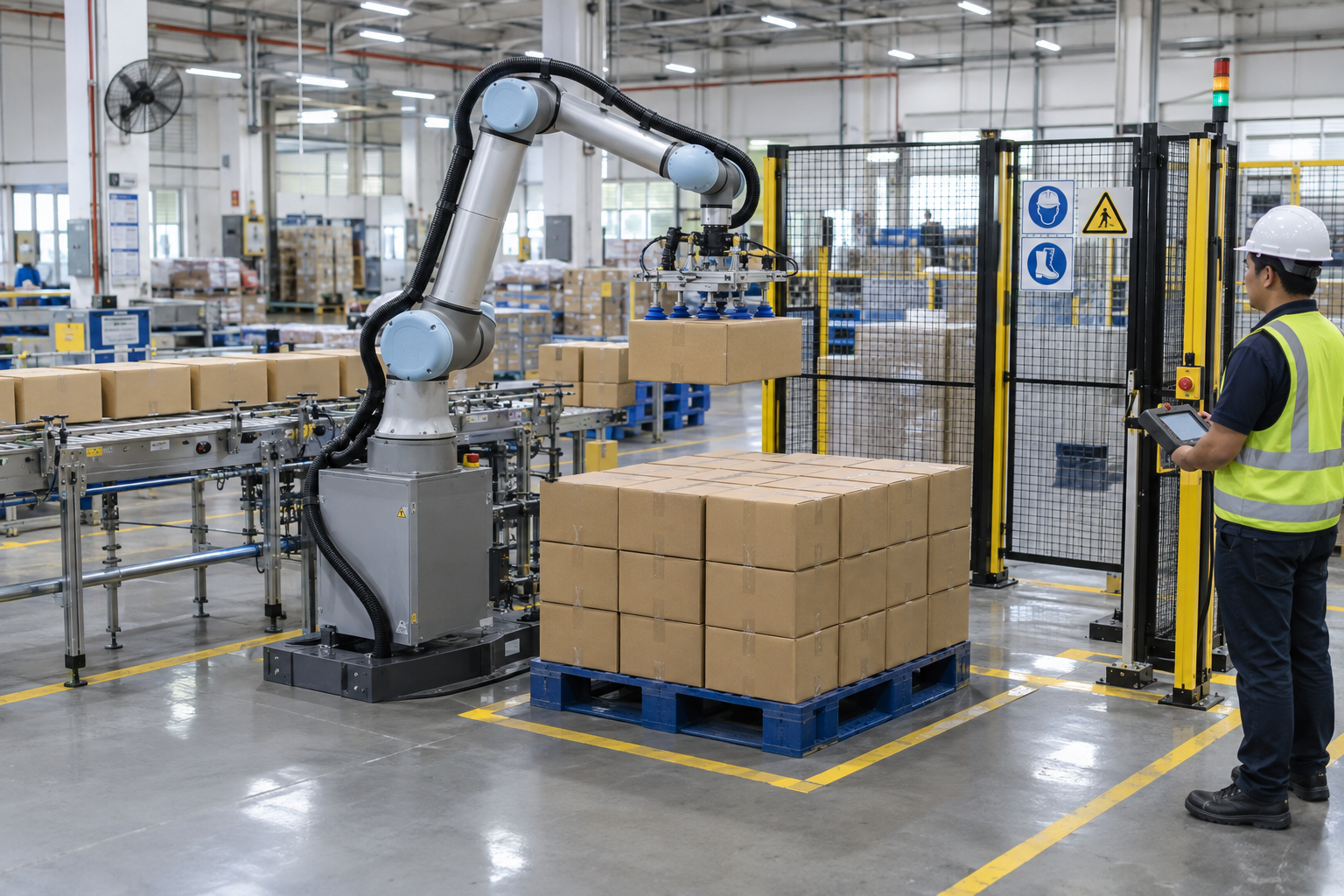
A cobot palletizer is an automated end-of-line solution that picks cases or cartons from an infeed and stacks them on a pallet according to a defined pattern. A complete cell may also include pallet handling, grippers, software, sensors and optional lifting equipment. Pallet feeding or removing pallets can be part of the wider automation process, but these functions must be included in the application scope rather than assumed.
Start with a first-pass fit test. A cobot palletizer is more likely to deserve a feasibility review when:
For resource-strapped production teams, the case for a cobot palletizer may extend beyond stacking cartons. Automating repetitive manual tasks such as feeding empty pallets, placing cases and removing completed pallets can reduce the amount of routine handling that operators must coordinate. However, “automating the entire process” should mean the defined end-of-line scope—not an assumption that every pallet movement is included. Confirm whether pallet dispensing, full-pallet transfer, product infeed and fault recovery are part of the proposed cell. These interfaces can affect the layout, controls, operator workload and feasibility of the project, so they should be tested together rather than added as an afterthought.
- The task is repetitive manual pallet stacking at the end of a production or packaging line.
- Carton presentation, orientation and product identity can be made predictable enough for reliable picking.
- Your products, pallet configurations or production plans change often enough that reprogramming and flexible tooling would be useful.
- Available floor space, access routes or the need to keep the cell adaptable make a large fixed installation unattractive.
- The required output, product weight and reach remain within the selected robot, gripper and cell design after real testing.
These conditions are not automatic approval criteria. A cobot palletizer can be flexible and suitable for modern production environments, but a high-speed continuous line, heavy or unstable packages, or complex pallet handling may favour another architecture. A conventional industrial robot palletizer may require more investment, time and floorspace, yet provide a better fit where output and payload dominate the decision.
Flexibility alone is not a reason to choose a cobot palletizer. Treat high-speed continuous output, heavy or unstable packages, and complex pallet handling as prompts to compare an industrial-robot cell as well. For a cobot proposal, require representative validation of carton presentation, payload, reach, pallet patterns, changeovers and recovery before deciding; a successful demonstration with one carton does not establish dependable performance across the defined product range.
Mixed carton sizes and frequent changeovers do not disqualify a cobot palletizer, but they increase the importance of application validation. The infeed must present each product with a predictable orientation and spacing, while the gripper must hold the different surfaces and dimensions reliably. The integrator should test the complete product range, pallet configurations and recipe changes, including any product that is difficult to pick. A single successful demonstration with one carton cannot establish that changeovers will be dependable or require minimal adjustment.
Application Inputs That Decide Feasibility
Do not begin with a robot model. Begin with a process description that an integrator can build and test. The palletizing application normally needs a clear path from infeed to completed pallet: product presentation, picking, end-of-arm tooling, pallet pattern, pallet positions, controls and output flow.
A palletizing cell may be described as a collaborative solution for a serialized production line, but that label does not remove the need to define the line interface. Record how product identity, order or recipe selection, infeed signals and pallet-pattern instructions reach the cell. The resulting design may combine the robot with grippers, sensors, software and pallet-handling equipment. Treat the cell as one end-of-line system, then validate the interaction between those components during representative trials rather than assessing the robot arm in isolation.
Prepare product, pallet and operating data
| Input | What to document | Why it matters |
|---|---|---|
| Product and carton | Dimensions, weight, surface, centre of gravity, orientation and permitted contact areas | These factors affect payload feasibility, grip reliability and whether vacuum, mechanical or hybrid tooling should be tested. |
| Infeed | Conveyor height, product spacing, orientation, rate and upstream signals | The robot can only repeat a palletizing cycle if product presentation is sufficiently predictable. |
| Pallet pattern | Pattern drawings, layer count, stacking height, pallet sizes and product rotation rules | Reach, wrist orientation, stability and cycle time can change between patterns. |
| Changeover | Number of products and pallet configurations, changeover frequency and operator involvement | Frequent changes may justify flexible software and tooling, but the changeover method still needs testing. |
| Site and utilities | Cell footprint, access, floor condition, electrical supply, compressed air, network connection and pallet supply | These constraints determine whether the proposed workcell can be installed and operated as intended. |
Payload must include the gripper, brackets and any tooling, not only the carton. A vacuum tool may suit a clean, accessible top surface, while a mechanical or hybrid end-effector may be preferable when the surface, access or location control makes suction unreliable. Test the complete product range rather than approving a tool from one demonstration carton. Chin Tech’s collaborative robot gripper selection guide provides a deeper framework for comparing electric, vacuum and custom end-effectors.
Also specify the number of pallet locations, the required stacking height and how full pallets will leave the cell. A lifting column, pallet station or multiple pallet positions may change the layout and reach calculation. A tool marketed for cobot palletizing may use compressed-air vacuum, but the supplier must confirm air quality, consumption and performance for your cartons.
When comparing proposals, ask what configuration options are included rather than treating “palletizer” as a complete specification. Different grippers may be needed for different carton surfaces or product formats; the number of pallet positions affects both changeover and floor layout; and the required palletizing height affects reach and stability checks. Application kits or standard components may help structure a proposal, but the supplier still needs to confirm that the selected components work with your actual cartons, patterns, pallet locations and operating sequence.
Cobot Palletizer vs Industrial Robot Palletizer: Trade-offs
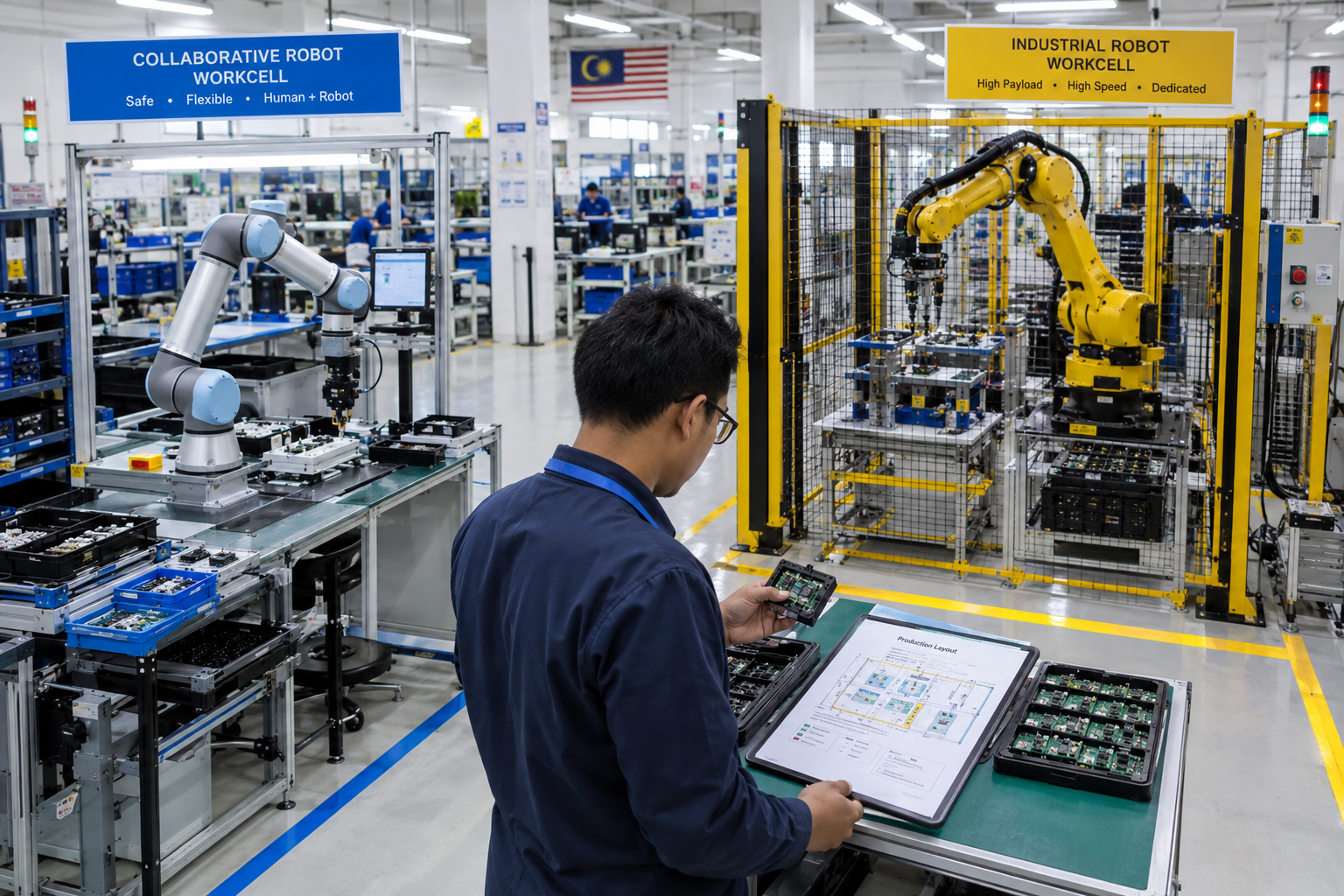
The right comparison is not “safe cobot versus unsafe industrial robot”. Both are integrated robot applications requiring an appropriate risk assessment. A cobot may have power- and force-limiting functions and may stop when contact is detected, but those features do not remove risks from the gripper, cartons, pallets, pinch points, stored energy or surrounding equipment.
Assess safety for the complete cell rather than the robot arm alone: access, foreseeable contact, the gripper, cartons, pallets, surrounding equipment, operating modes, safeguarding and recovery all matter. The OSHA robotics standards and technical references provide general robotics safety material, while the International Federation of Robotics guidance treats risk assessment as part of collaborative robot applications. These are not a substitute for Malaysian legal or site-specific advice, so have a qualified safety reviewer confirm the wording and the proposed cell assessment before deployment.
| Decision factor | Cobot palletizer | Industrial robot palletizer |
|---|---|---|
| Flexibility | Can be attractive where products and pallet patterns change, provided programming and tooling support those changes. | Can also handle multiple patterns, but the cell may be more dedicated and require more substantial changeover planning. |
| Footprint and layout | May suit a compact or adaptable workcell, subject to reach, pallet access and safeguarding. | May require more space and infrastructure, especially for higher-speed or larger payload applications. |
| Output | Must be demonstrated using the real carton, pattern, gripper and recovery conditions. | May be the stronger candidate for continuous, high-output lines, but the actual specification still requires validation. |
| Payload | Check the combined mass of product, end-effector and mounting hardware against the selected arm’s documented limits. | Often considered when package weight, reach or production rate exceeds the practical envelope of a cobot cell. |
| Safety arrangement | Human proximity may be part of the design, but it still needs application-specific risk reduction and validation. | Guarding and controlled access may be more prominent, depending on speed, reach and cell hazards. |
| Economics | Assess integration, tooling, utilities, training, maintenance and expected output rather than assuming a lower total cost. | Compare higher infrastructure or capital requirements against the output and operating capability actually needed. |
A Practical Selection and Site-Assessment Checklist
Before approving a quotation, ask the integrator to address these points in a written feasibility review:
- Define the requirement: state products, weights, dimensions, output target, operating schedule, pallet types and acceptable placement quality.
- Map the cell: show the infeed, robot position, pallet locations, operator access, completed-pallet route and available floor space.
- Test the end-effector: use representative cartons, including difficult surfaces, damaged packaging and the full product range where possible.
- Check patterns and changeovers: test the required layers, stacking height, rotations, pallet positions and the time and skill needed to change recipes.
- Review interfaces: confirm conveyor signals, pallet detection, sensors, I/O, data exchange, compressed air and electrical requirements.
- Document safety controls: request the proposed risk-assessment method, access controls, protective devices, operating modes and recovery procedure.
- Agree acceptance tests: define how output, placement quality, stoppages, changeovers and fault recovery will be measured with representative products.
- Plan lifecycle support: clarify programming access, operator training, maintenance, spare parts, troubleshooting and support for future product variants.
A demonstration should not use only the easiest carton and one pallet pattern. A meaningful trial includes representative products, patterns and changeovers, then records the conditions under which the system meets or misses the agreed result.
Decision Checklist and Next Step
Choose a cobot palletizer when the documented application shows a workable combination of product presentation, payload, reach, output, changeover needs, layout and safety controls. Choose an industrial robot or another architecture when the required speed, package mass, reach, continuous duty or cell arrangement cannot be validated within a cobot design. In either case, decide from measured application evidence—not from the word “cobot” in a product description.
For a supplier discussion, prepare carton samples or accurate product data, pallet drawings, target output, current manual process details, site photographs, available dimensions, utilities and the acceptance measures your team considers essential. You can review the palletizer robot solution page as a starting point, then contact Chin Tech to discuss whether a cobot palletizer or another palletizing approach should be assessed for your Malaysian facility.
Frequently Asked Questions
Can a cobot palletizer handle mixed carton sizes and frequent changeovers?
Yes, it can be considered for mixed carton sizes and frequent changeovers when the infeed, gripper, software and pallet patterns are validated across the actual product range. The integrator should test orientation, surface condition, product spacing and recipe changes rather than relying on a single carton demonstration.
What safety features should a Malaysian factory require?
Require a documented application-specific risk assessment, access controls, protective stops or monitored devices where necessary, safe operating procedures and a clear recovery method. A collaborative robot’s force- or power-limiting functions do not by themselves address hazards from cartons, pallets, grippers, trapping points or the wider cell.
How can we check whether a cobot palletizer will meet throughput?
Provide the required output, product sample or complete product data, pallet pattern, infeed conditions and changeover requirements. Ask for a cycle-time trial that includes picking, placement, tool movement, pallet changes and recovery conditions; a headline robot speed is not enough to confirm completed-pallet output.
Prepare Your Palletizing Assessment
Make the proposal scope explicit before comparing prices or architectures. Ask the supplier to state whether it includes carton presentation, the gripper, pallet positions, stacking height, full-pallet removal, product and recipe signals, and fault recovery. Those interfaces can change the layout, operator workload and feasibility of the cell; confirm them against your actual products and pallet patterns.