
AGV vs AMR: Which mobile-robot strategy should Malaysian manufacturers choose?
Compare AGVs and AMRs for Malaysian factories by navigation, route flexibility, integration, safety and total project cost before choosing a mobile-robot strategy.
AGV vs AMR: Which mobile-robot strategy should Malaysian manufacturers choose?
Choose an automated guided vehicle (AGV) when material transfers follow stable, predictable routes. Consider an autonomous mobile robot (AMR) when routes, workstations or delivery priorities change regularly. Neither is automatically cheaper, safer or more productive. The better choice is the system that meets your required throughput, load profile, site conditions and integration needs with manageable operating risk.
For Malaysian manufacturers, the most reliable starting point is a map of the actual material flow. Identify where loads originate, where they must arrive, how often they move and what happens when a route becomes unavailable. Only then should you compare navigation technology, suppliers or project quotations.
What is the difference between an AGV and an AMR?
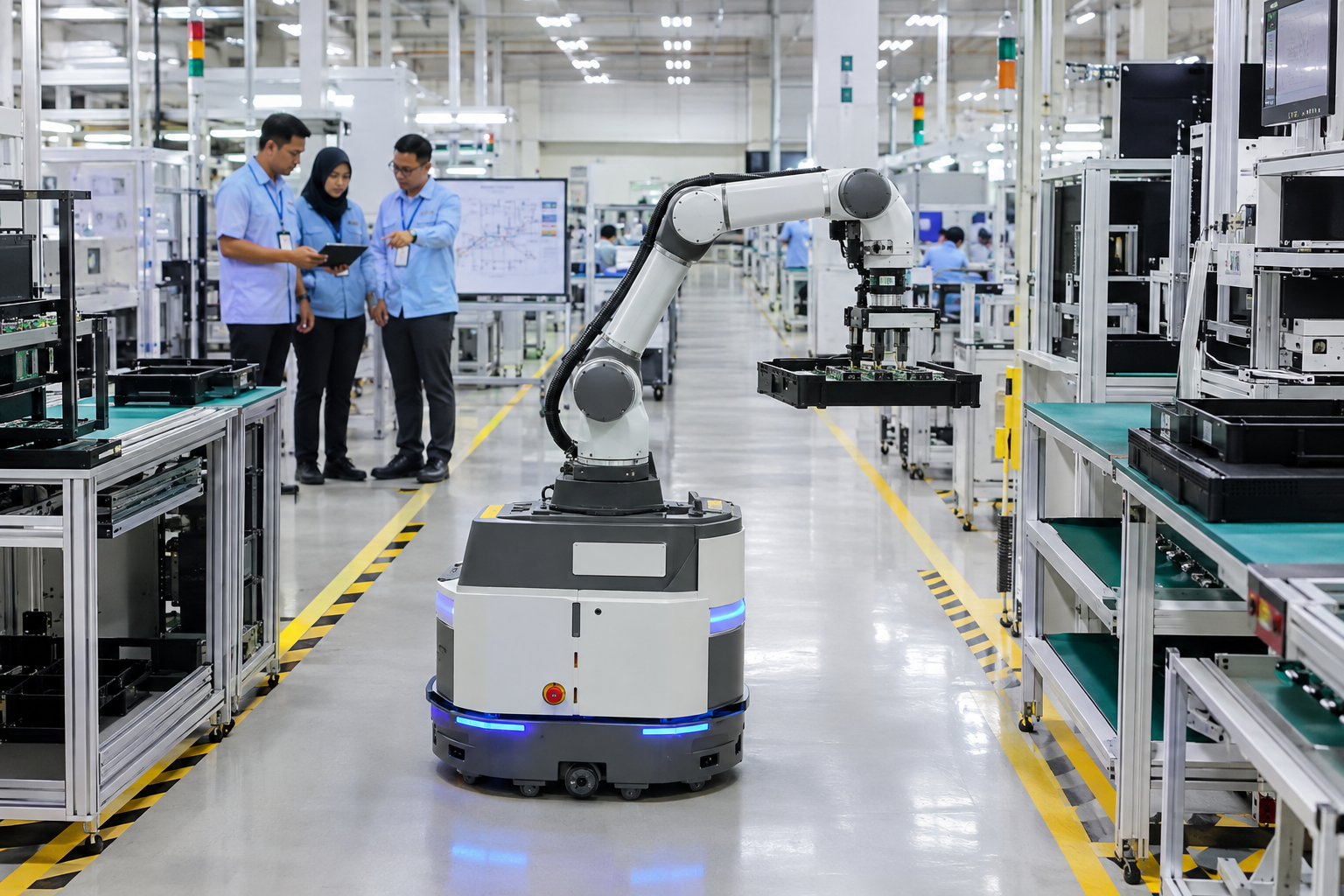
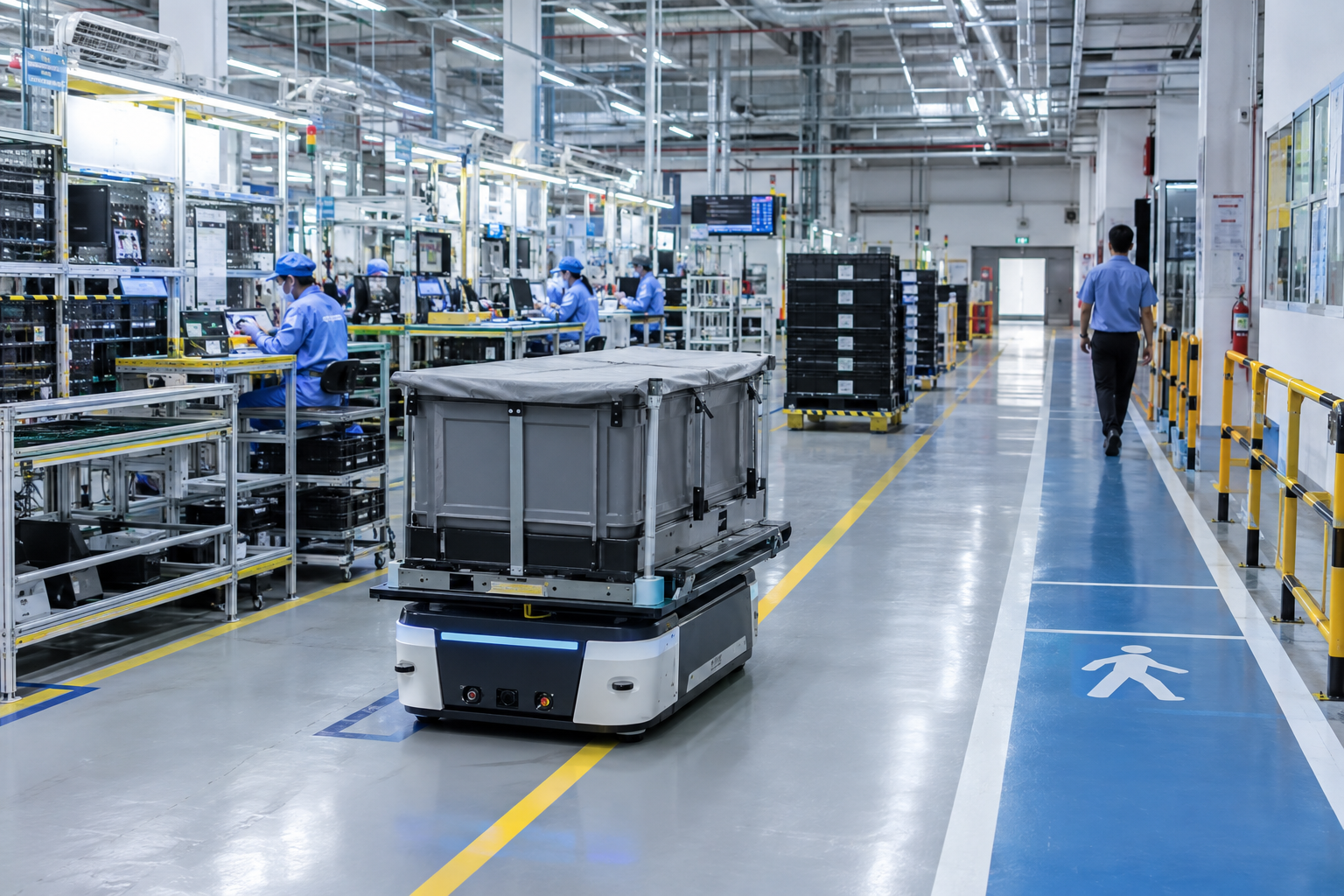
The practical difference lies in how each system navigates and responds to changes. Traditional AGVs typically travel along predefined routes using guidance methods such as magnetic tape, markers, reflectors or programmed paths. AMRs generally combine localisation sensors with software-based mapping and path planning, allowing suitably configured systems to select or adjust routes as their surroundings change.
However, these categories are not absolute. Some AGVs use sophisticated laser guidance, while AMRs still operate within defined maps, traffic rules and system limits. Sensor capability alone does not prove that a vehicle can negotiate a particular aisle, recover from an obstruction or interact safely with workers. Ask each supplier to explain the navigation method used by the proposed model rather than relying on the AGV or AMR label.
Factory example: A plant that repeatedly transfers the same trays between two unchanged production areas may find a guided route straightforward to manage. Another plant that regularly reallocates assembly stations may benefit from software-managed routes, provided the proposed AMR can accommodate its layout and traffic conditions.
AGV vs AMR: comparison for Malaysian factory workflows
Compare complete workflows, not just vehicle features. Navigation matters, but so do hand-off reliability, charging, exception handling and integration with the production schedule. Use the same load and operating assumptions when reviewing both technologies.
| Decision factor | AGV: typical consideration | AMR: typical consideration | What to verify |
|---|---|---|---|
| Navigation | Follows a defined guidance strategy and approved routes. | May plan or adapt routes within a mapped operating area. | Actual positioning method, map limits and response to obstructions. |
| Layout changes | Route alterations may require changes to guidance or programming. | Route updates may be easier, subject to remapping and validation. | Who changes routes, how long it takes and how changes are approved. |
| Traffic and access | Controlled paths can simplify a predictable traffic arrangement. | Dynamic routing may offer options around changing obstructions. | Shared aisles, pedestrians, forklifts and stopping behaviour. |
| Load handling | Vehicle, carrier and hand-off must suit the load. | Vehicle, carrier and hand-off must suit the load. | Model-specific payload, load stability, travel conditions and interfaces. |
| Integration | Connects route logic with stations, conveyors and controls as required. | May involve fleet software, mapping, dispatching and system interfaces. | Signals, job release, error recovery and responsibilities. |
| Project cost | Include guidance, route changes, maintenance and support. | Include mapping, software, fleet operation, maintenance and support. | Complete, itemised project scope and cost of future changes. |
For instance, two proposals may use similar vehicles but include very different charging equipment, software licences, site modifications and commissioning work. The table only helps shortlist an approach; the project-specific quotation determines what the factory is actually buying.
When should a manufacturer choose an AGV?
An AGV deserves serious consideration when a facility has consistent material flows and relatively stable pickup and drop-off points. Predictable routes can make the transport sequence easier to specify, especially when operators already follow established production schedules and access rules.
The main trade-off is the effort involved in changing that arrangement. If a production line moves, the buyer may need to revise guidance infrastructure, software logic or operating procedures. Accordingly, evaluate the expected frequency of layout changes, rather than treating the present floor plan as permanent.
Example: An electronics manufacturer transfers component trolleys from a central store to the same assembly line each shift. An AGV could be a suitable candidate if its load capacity, hand-off design, travel time and route protection meet the site’s requirements. The supplier still needs to demonstrate these conditions with representative loads.
When is an AMR the more suitable choice?
An AMR may offer greater operational flexibility when a factory frequently changes routes, workstations or delivery priorities. Software-managed navigation can make it easier to revise transport patterns without rebuilding a fixed guidance route, although the extent of that flexibility depends on the equipment and operating environment.
In practice, dynamic navigation is only one part of the solution. The factory must still define material requests, pickup and drop-off procedures, traffic priorities, charging arrangements and recovery from interruptions. Product-status tracking, where required, depends on the connected identification and management systems; it is not an inherent feature of every AMR.
Example: Consider a high-mix production floor where workstations change position as product demand shifts. An AMR might support different delivery patterns more conveniently than a fixed route. Nevertheless, the supplier should show how updated maps, new hand-off points and shared-aisle conditions would be assessed before the revised workflow enters production.
What information should buyers collect before requesting proposals?
Prepare a common process brief so every supplier evaluates the same task. Without consistent inputs, a lower quotation may simply exclude work that another supplier has included.
- Material flow: Mark each pickup point, delivery point, queue and exception route on a current floor plan.
- Load profile: Record the weight, dimensions, centre of gravity, carrier type and loading method for representative materials.
- Operating demand: Specify travel distances, trip frequency, shift patterns and required availability.
- Site conditions: Identify aisle widths, doors, ramps, floor changes, restricted zones and existing traffic.
- Future changes: Describe likely adjustments to workstations, production schedules, product mix and routes.
- System interfaces: List conveyors, machines, warehouse or production software, call signals and hand-off devices.
- Abnormal conditions: Describe what should happen when a route is blocked, a destination is unavailable or a transfer fails.
- Project support: State expectations for training, maintenance, spare parts, documentation and handover.
A useful brief is specific enough to test. For example, instead of asking for a “fast AMR”, state the required delivery window, operating route and load conditions. The supplier can then explain whether the proposed system is capable of meeting them.
How should AGV and AMR safety be assessed?
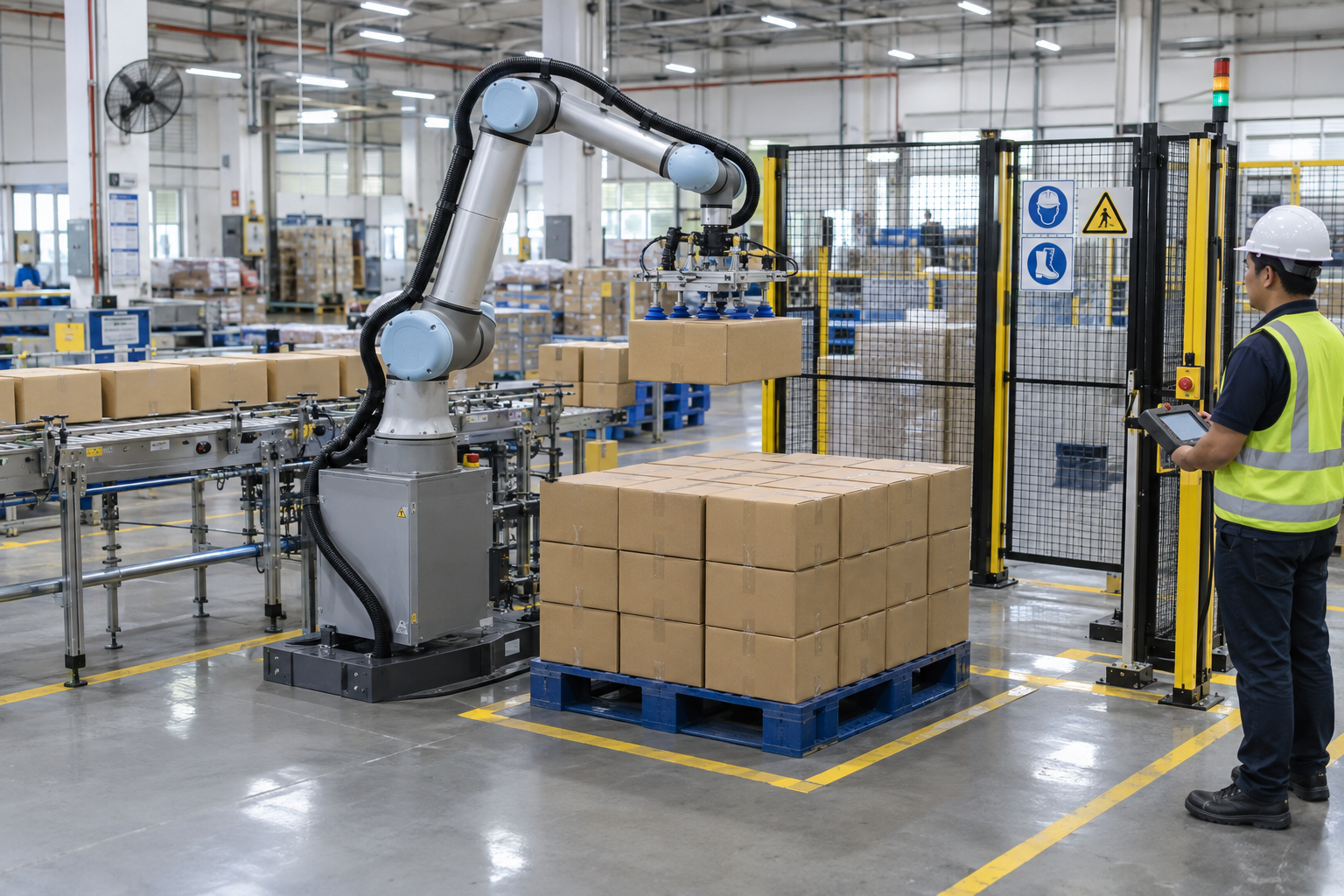
Neither a predefined path nor autonomous obstacle detection makes a complete installation automatically safe. Assess the proposed equipment within the actual operating area, including its interaction with people, forklifts, loading stations and other machinery.
AGV and AMR safety should be assessed in the context of the actual manufacturing environment. Factory operators should consider the proposed equipment, traffic conditions, operating areas and interactions with people or other machinery. Before installation, the supplier and a qualified safety professional should identify applicable technical and legal requirements, assess site-specific risks and agree on suitable safeguards. The assessment should document the installation’s operating conditions and any further verification required before commissioning.
For a Malaysian installation, ask the supplier, integrator and qualified safety personnel to establish which requirements apply, document the site-specific risk assessment and agree how the resulting safeguards will be reviewed. Do not assume that a product description or an ISO reference substitutes for that work.
Example: If a proposed route crosses an aisle used by forklift operators, the review should consider how the selected vehicles and local traffic arrangements will interact. The project team can then define suitable controls and evidence of verification for that site, rather than assuming that one manufacturer’s generic obstacle-detection claim settles the question.
How does integration affect the AGV versus AMR decision?
The vehicle must work with the production process at both ends of the journey. Navigation alone cannot ensure that a machine receives the correct material, that a transfer is completed or that the next transport request is triggered at the right moment.
For example, if an AMR delivers a tray to a collaborative-robot station, the team needs to define the stopping location, load presentation, arrival signal and hand-off sequence. If the downstream cell picks individual parts, its gripping method is a separate engineering decision. Chin Tech’s vacuum versus mechanical gripper guide explains the different workpiece and tooling considerations involved.
Likewise, a warehouse-management or production-control interface needs clearly defined responsibilities. Agree which system releases jobs, which records completion and how operators receive alarms when a transfer does not proceed as expected. These functions depend on the proposed integration; they should not be attributed automatically to every AGV or AMR.
How should suppliers validate performance before handover?
Translate the process brief into measurable acceptance criteria before commissioning begins. A User Requirements Specification (URS) should describe the required result, the conditions under which the system must achieve it and the evidence that will count as acceptance.
Factory Acceptance Testing (FAT) and Site Acceptance Testing (SAT), where appropriate to the contract, give the buyer and integrator opportunities to assess agreed functions before and after installation. Relevant checks might cover delivery timing under specified loads, confirmed station hand-offs or recovery from a route interruption. The exact checks and pass criteria should come from the approved requirements and risk assessment, not a generic test list.
Example: If the URS calls for a completed transfer between two stations within an agreed operating window, the team can specify the representative load, route, traffic assumptions and method of recording results. A demonstration on an empty floor would not, by itself, establish performance under normal production conditions.
For practical guidance on defining those acceptance measures, refer to Chin Tech’s URS, FAT/SAT and handover guide.
How should you compare the total project cost?
Compare the cost of a working, supported transport process rather than the price of a vehicle alone. A complete quotation should make it clear which equipment, software, infrastructure and engineering services the supplier will deliver.
Request separate line items for guidance or mapping, charging, carriers, machine interfaces, fleet-management functions where relevant, site preparation, installation, commissioning, training and maintenance. Also ask who will update the system when routes change and whether the proposed support arrangements cover those changes.
Example: A lower equipment-only offer might require the factory to arrange integration and commissioning independently. Another proposal might include those services. Neither can be judged fairly until both cover the same deliverables and operating assumptions. This comparison does not require speculative Malaysian market prices or unsupported payback claims.
A four-step selection process for Malaysian manufacturers
Make the decision in stages, with evidence at each stage. This limits the risk of committing to a vehicle before the factory understands the complete workflow.
- Map the operation: document loads, routes, traffic, delivery frequency, exceptions and expected layout changes.
- Shortlist the architecture: compare AGV and AMR concepts against the same technical and operating requirements.
- Validate the proposal: request representative demonstrations or agreed acceptance tests, together with an application-specific safety review.
- Confirm commercial scope: compare documented inclusions, exclusions, responsibilities, maintenance and handover requirements.
When shortlisting automation partners, consider their technical expertise, integration approach, documentation and local support arrangements. For a more structured evaluation, read Chin Tech’s guide to evaluating automation integrators in Penang. Before selecting equipment, ask each supplier to confirm the proposed solution’s specifications, availability, suitability and integration requirements against your factory’s actual operating conditions.
Frequently Asked Questions
Does a changing factory layout automatically make an AMR the better choice?
No. Frequent changes can favour a more adaptable navigation approach, but the choice still depends on payload, traffic, floor conditions, integration and the cost of updating routes. Ask suppliers to demonstrate how the proposed system handles your expected changes.
Do AGVs always carry heavier loads than AMRs?
No. Payload depends on the particular vehicle, carrier, operating conditions and duty cycle. Compare documented model-specific limits rather than assuming that one category has a higher capacity.
Is an AMR automatically safer because it detects obstacles?
No. Obstacle detection is only one feature of a complete installation. The supplier and qualified safety personnel should review the operating area, interactions with people and other equipment, and the safeguards required for the actual site.
What should a factory ask for before accepting an AGV or AMR proposal?
Request a defined scope, documented assumptions, model-specific specifications, an application-specific safety review and agreed acceptance criteria. Where FAT or SAT forms part of the project, confirm the test conditions, records and handover responsibilities in advance.
Plan an AGV or AMR project around your actual workflow
Bring your factory floor plan, load information, material-transfer sequence and expected layout changes to the supplier discussion. If you would like to explore a suitable material-handling solution, contact Chin Tech with your project requirements. Ask the team to clarify which equipment and services are available and what further technical assessment your application may require.