

In today’s competitive manufacturing landscape, efficiency is no longer optional—it is a core requirement for survival. Companies across Malaysia are increasingly turning to industrial automation to reduce downtime, improve production consistency, and optimize operational costs.
A key driver behind this transformation is the automation system integrator in Malaysia, who bridges the gap between machinery, robotics, software, and production workflows to create fully optimized manufacturing systems.
One example of a trusted industry player in this space is Chintech, which focuses on delivering integrated robotics, AMR solutions, and end-effector systems for modern factories.
What Does an Automation System Integrator Do?
An automation system integrator is responsible for designing, implementing, and optimizing complete automation solutions within a manufacturing environment.
Instead of supplying just a single machine or robot, they ensure that:
- Robotics systems work seamlessly with production lines
- Software communicates effectively with hardware
- Material handling is optimized
- Human-machine interaction is safe and efficient
- Downtime is minimized through smart system design
In simple terms, they turn disconnected equipment into a fully synchronized production ecosystem.
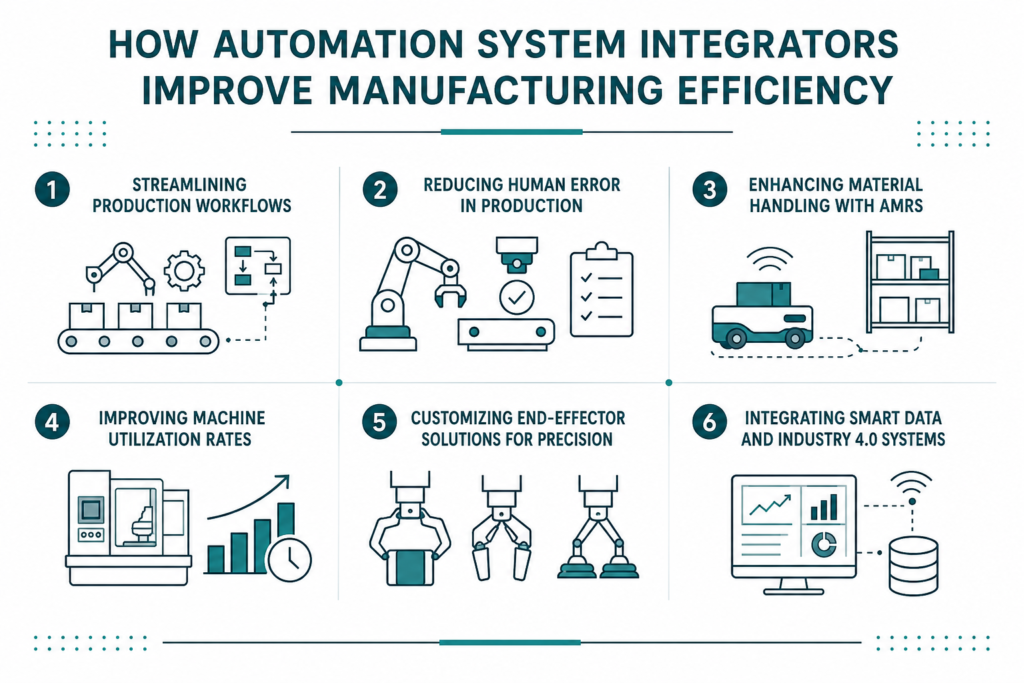
How Automation System Integrators Improve Manufacturing Efficiency
1. Streamlining Production Workflows
One of the most significant benefits of working with an automation system integrator in Malaysia is workflow optimization.
They analyze production bottlenecks and redesign processes so that materials, machines, and workers operate in a smooth and continuous flow.
This results in:
- Reduced idle time
- Faster cycle times
- Better resource utilization
2. Reducing Human Error in Production
Manual processes are often prone to inconsistencies. Automation system integrators reduce dependency on repetitive human tasks by introducing:
- Industrial robots
- Vision inspection systems
- Automated quality control
- Precision end-effectors
This leads to higher product consistency and fewer defects.
3. Enhancing Material Handling with AMRs
Modern factories increasingly rely on Autonomous Mobile Robots (AMRs) to move materials efficiently across production floors.
An experienced integrator ensures that AMRs:
- Navigate safely in dynamic environments
- Integrate with warehouse systems
- Operate alongside human workers
- Optimize internal logistics routes
This significantly reduces manual transportation workload and improves overall efficiency.
4. Improving Machine Utilization Rates
A well-designed automation system ensures machines operate closer to their optimal capacity.
System integrators achieve this by:
- Balancing production loads
- Synchronizing upstream and downstream processes
- Minimizing machine idle time
- Implementing predictive maintenance systems
Higher machine utilization directly translates into increased output without additional capital investment.
5. Customizing End-Effector Solutions for Precision
End-effectors are the “hands” of robotic systems, and their design determines how effectively a robot performs tasks such as gripping, welding, or assembling.
A strong automation system integrator customizes end-effectors to:
- Match specific product shapes
- Improve gripping accuracy
- Reduce cycle time
- Increase flexibility across production lines
This customization is crucial for industries with complex or delicate manufacturing requirements.
6. Integrating Smart Data and Industry 4.0 Systems
Modern manufacturing is driven by data. System integrators connect machines and software platforms to enable real-time monitoring and analytics.
This allows manufacturers to:
- Track production efficiency in real time
- Identify bottlenecks instantly
- Predict maintenance needs
- Improve decision-making through data insights
This shift toward smart factories is a key pillar of Industry 4.0 adoption in Malaysia.
Solutions and Product Categories in Industrial Automation
A strong automation system integrator in Malaysia does not rely on a single type of solution. Instead, they combine multiple technologies and components to build a complete and functional automation ecosystem.
For example, companies like Chintech provide a range of integrated automation solutions that support different stages of manufacturing and logistics operations.
Industrial Robots
Industrial robots are widely used to automate repetitive and precision based tasks such as assembly, welding, pick and place, and packaging. They help manufacturers improve production speed, accuracy, and consistency while reducing reliance on manual labor.
Autonomous Mobile Robots (AMR)
Autonomous mobile robots (AMR) are designed to handle internal logistics and material transport within factories and warehouses. They use intelligent navigation systems to move safely in dynamic environments without fixed routes, improving operational flow and reducing manual handling requirements.
End Effector Systems
End effectors are the tools mounted on robotic arms that allow interaction with products. These include mechanical grippers, vacuum systems, and application specific custom tools. Proper end effector selection is essential for achieving precision, stability, and efficiency in automated processes.
Automation Accessories and Integration Components
Automation systems also require supporting components such as sensors, controllers, safety devices, and communication modules. These elements ensure that all machines and systems operate in sync and maintain stable performance across production environments.
Fully Integrated Automation Systems
The highest value is achieved when all components are integrated into a unified system. This includes robots, AMRs, end effectors, and control systems working together under a coordinated automation framework. A well designed integration allows manufacturers to streamline workflows, reduce downtime, and improve overall productivity.
Automation Solutions Overview
| Solution | Main Function | Benefit |
| Industrial Robots | Automate production tasks | Higher speed and consistency |
| AMR | Internal material transport | Faster and safer logistics flow |
| End Effectors | Robot interaction tools | Improved precision and flexibility |
| Control Systems | System coordination | Better stability and uptime |
Why Expertise Matters in Automation System Integration
Not all automation solutions deliver the same results. The effectiveness of an automation system depends heavily on the expertise of the integrator.
A reliable automation system integrator in Malaysia must have:
- Strong engineering and robotics knowledge
- Experience across multiple industries
- Understanding of production workflows
- Ability to customize solutions based on factory needs
- Proven implementation track record
Companies like Chintech demonstrate how technical expertise and system-level thinking can significantly improve manufacturing performance.
Real Impact on Manufacturing Efficiency
When properly implemented, automation systems can deliver:
- Up to 30–70%improvement in productivity (depending on application)
- Significant reduction in labor-intensive processes
- Improved product consistency and quality
- Lower operational costs over time
- Faster return on investment (ROI)
These benefits make automation not just a technology upgrade, but a long-term strategic investment.
Conclusion
Manufacturing efficiency today depends heavily on how well systems are integrated—not just how advanced individual machines are.
An experienced automation system integrator in Malaysia plays a critical role in connecting robotics, AMRs, end-effectors, and software into a unified production ecosystem.
By partnering with experts like Chintech, manufacturers can move toward smarter, faster, and more reliable production systems aligned with Industry 4.0 standards.
Frequently Asked Questions
What does an automation system integrator in Malaysia do?
An automation system integrator in Malaysia designs, installs, and connects different automation technologies such as robots, AMRs, sensors, and control systems into a complete production system. This helps manufacturers improve efficiency, reduce manual work, and achieve more consistent operations.
How do I know if my factory needs automation?
If your production line involves repetitive manual processes, inconsistent product quality, high labour dependency, or frequent downtime, automation can help improve productivity, operational consistency, and overall cost efficiency.
What is the difference between industrial robots and AMRs?
Industrial robots are designed for fixed automation tasks such as assembly, welding, and packaging, while Autonomous Mobile Robots (AMRs) are used for internal logistics and material transportation within factories and warehouses.
Is automation suitable for small and medium manufacturers in Malaysia?
Yes. Automation solutions are increasingly scalable and suitable for small and medium manufacturers in Malaysia. SMEs can begin with partial automation, such as robotic workstations or AMR systems, and gradually expand based on production requirements and budget.
How long does it take to implement an automation system?
The implementation timeline depends on the complexity of the automation project. Simple systems may be completed within a few weeks, while fully integrated production lines may take several months, including system design, installation, testing, and optimization.

