
Choosing between cobot manufacturers is less about “which arm is best” and more about which complete solution will run reliably on your line. In Malaysian factories, the right choice depends on the application (machine tending, assembly, auto soldering, packaging, inspection), the real risks around people, and the quality of local support when downtime isn’t an option.
This beginner-friendly guide explains what to compare—safety, programming, payload and reach, and service support—plus practical questions to ask before purchasing a cobot or commissioning a full automation system integration.
1) Safety: what “collaborative” really means on your floor
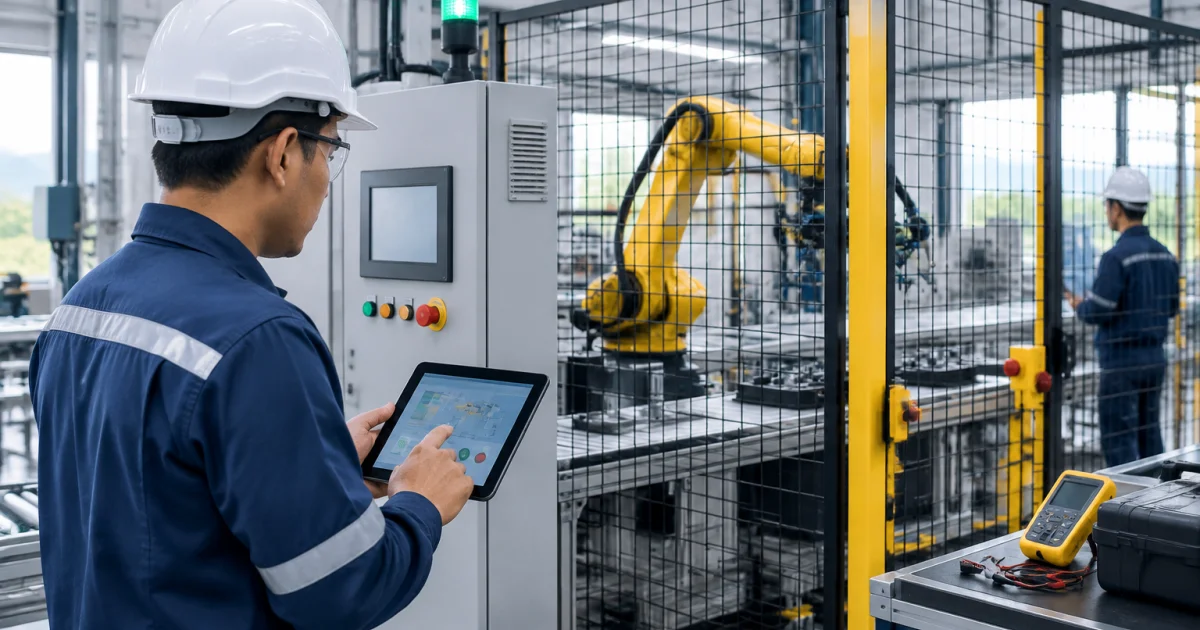
A cobot is not automatically “safe without guarding.” Safety is a system outcome based on speed, payload, tooling, and the process. The same cobot can be deployed fully collaborative (sharing space), partially collaborative (limited interaction), or like a traditional robot (with fencing) depending on the hazards.
When comparing manufacturers, look at the safety functions available and how straightforward it is to validate safe operation after installation—and after future process changes.
Safety functions to compare (and why they matter)
- Force/torque limiting and power & force limiting (PFL): suitable when forces are low. If you have sharp edges, pinch points, rotating tools, or heat, PFL alone may not be sufficient.
- Speed and separation monitoring: typically via safety-rated scanners or 3D sensors. This enables higher throughput while slowing/stopping the robot when people approach.
- Safety-rated monitored stop and safe speed limits: helps define zones (e.g., slower near operators, faster when clear).
- Emergency stop architecture and safety I/O: impacts how easily you integrate interlocks, conveyors, and machine safety devices.
Tooling and application hazards: the “hidden” safety difference
Two arms can have similar collaborative ratings, yet very different risk once you mount tooling. A vacuum gripper handling cartons is not the same as a servo screwdriver, deburring spindle, or soldering tool. More process energy (heat, sharp contact, rotation, compressed air) usually means additional safeguarding such as guarding, interlocks, or area monitoring.
Ask each vendor/integrator how they will handle safety for your exact use case (e.g., machine tending with an open chuck, grinding/polishing, robotic soldering with hot tips and fumes). Strong suppliers discuss risk assessment, cell design, and validation—not only robot specs.
Practical safety checklist for Malaysian factories
- Can you define operating modes clearly: setup, teaching, auto run, maintenance?
- What changes when product variants or tooling are introduced?
- How will you access fixtures, feeders, or vision inspection machines without bypassing safety?
- Who documents final safety settings and trains operators on safe recovery after stops?
2) Programming and usability: faster commissioning, easier changeovers
Programming often determines whether a cobot saves time or creates ongoing work. Two systems may share similar payload and reach, but differ greatly in commissioning effort, changeover speed, and how easily technicians can troubleshoot.
Go beyond “easy” demos and evaluate teaching, logic, communication, and error recovery under real shift conditions.
What to compare in programming
- Teach pendant and UI flow: clear for operators/maintenance (not only engineers). Can you lock critical settings while still enabling routine tasks?
- Hand-guiding and waypoint teaching: fast path creation—check repeatability for your tolerances.
- Offline simulation and deployment: useful for validating reach, collisions, and cycle time before hardware arrives.
- I/O and fieldbus support: integration with PLCs, conveyors, tools, and sensors often drives the real workload. Confirm supported protocols and local references.
- Error handling and restart behavior: after vacuum loss, missing parts, or vision mismatch, can the program recover safely without constant manual intervention?
Integration features that matter for real applications
Many projects in robotic automation Malaysia go beyond pick-and-place, adding feeders, torque tools, force control, and cameras. If a robotic vision inspection system is part of your plan, verify camera/lighting integration, inspection logic (pass/fail sorting, barcode/QR reads, orientation checks), and traceability signals back to MES/PLC.
For electronics and auto soldering, programming depth matters: consistent approach angles, dwell time control, and stable motion. Ask whether the environment supports process routines, recipe management, and quick changeovers without rewriting core logic.
3) Payload, reach, and accuracy: reading specs the right way
Payload is often misunderstood. It includes not only part weight but also the gripper, brackets, cabling, quick changers, and off-center loading. Reach is also more than “can it touch the point”—it must reach with the correct orientation, within joint limits, and without collisions or singularities.
How to calculate the payload you really need
- Total tool + part weight: end-effector + mounting + sensors + workpiece.
- Center of gravity (CoG): longer tools create higher torque even at the same weight.
- Dynamic loads: acceleration/deceleration and repetitive motion may require margin for stability and repeatability.
In shortlist reviews, ask suppliers to confirm payload using your exact tool model and gripping method. If modular tooling is likely, factor future add-ons (e.g., force/torque sensor, quick changer).
Reach, workspace, and cell layout
Reach influences pedestal height, fixture placement, feeder position, operator access, and whether one robot can serve multiple stations. Some models maintain payload across different reaches; others trade reach for stiffness. If you need to tend two machines or pick from deep locations, reach and joint limits become decisive.
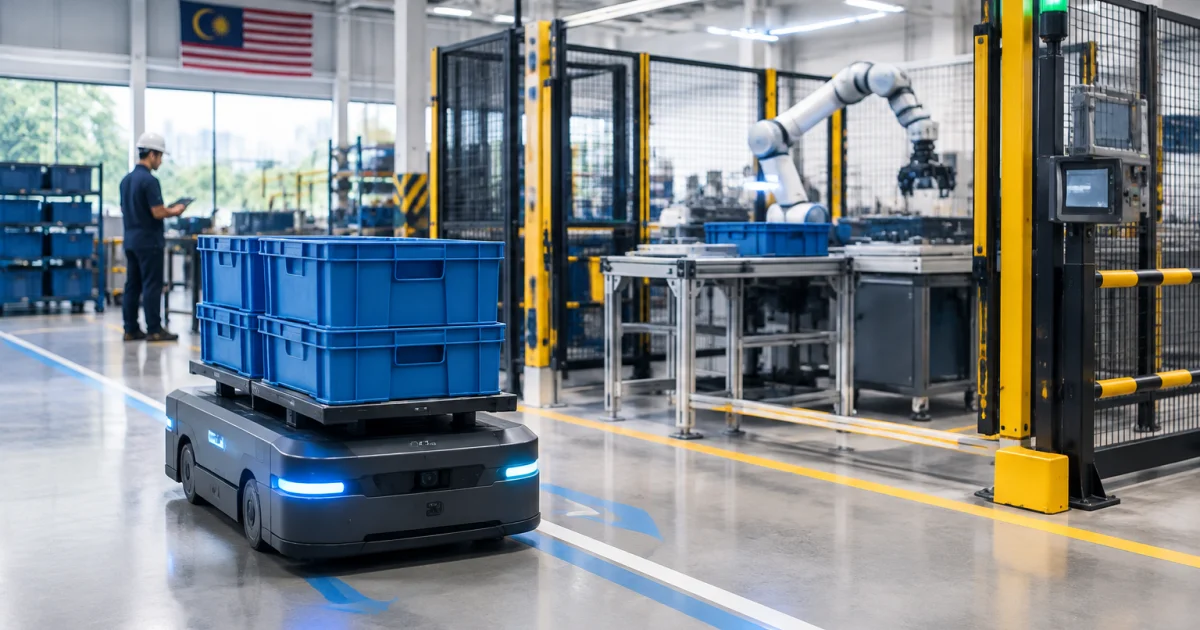
Request a basic layout study showing robot base location, operator positions, and material flow. If internal logistics is on your roadmap, consider how an AMR machine (autonomous mobile robot) might deliver totes/trays to the cell, which can affect mounting and reach decisions.
Repeatability vs. “accuracy” (and why it affects quality)
Repeatability is often the headline spec and is sufficient for many fixture-based tasks. For processes requiring tighter absolute positioning (some inspection setups, precision insertion, soldering paths), overall accuracy depends on calibration, fixturing, vision alignment, and environmental stability.
If vision inspection machines will guide the cobot, ask about camera-to-robot calibration tools and how drift is managed after maintenance or relocation.
4) Service support: the difference between a pilot and a dependable line
Support often determines long-term success. Similar-looking cobots can deliver very different ownership experiences depending on local spare parts, response time, training, and whether the provider can troubleshoot the whole cell (grippers, sensors, cameras), not only the arm.
What “support” should include (not just warranty talk)
- Application engineering: help selecting the right arm, gripper, and cell concept for takt time.
- Integration and commissioning: on-site setup, safety validation support, cycle-time tuning, and handover documentation.
- Operator and maintenance training: recovery, job loading, safe restart, first-line troubleshooting.
- Spare parts strategy: recommended spares, lead times, and Malaysia availability.
- Remote support tools: quicker diagnosis when you can’t wait for a site visit.
Local integration capability matters for complex cells
Most deployments include fixtures, machine interlocks, conveyors, and often a vision inspection system. If overseas support is required for routine issues, recovery time can stretch. A capable local integrator can take end-to-end responsibility for cell performance instead of leaving you to coordinate multiple suppliers.
If you are planning broader robotic automation Malaysia initiatives, confirm the provider can scale from one cobot to line-level solutions including vision, end-effectors, and material handling automation.
5) A practical comparison framework and questions to ask
Use a consistent scorecard so procurement, engineering, production, and EHS can evaluate options fairly.
Shortlist scorecard (example categories)
| Category | What to evaluate | Evidence to request |
|---|---|---|
| Safety | Risk controls for your tooling and speeds | Cell concept, safety devices list, validation approach |
| Programming | Changeover workflow, error recovery, PLC/IO integration | Demo using your use case, sample program structure |
| Payload & reach | Margin with tool + part + future add-ons | Payload calc with CoG, layout drawing |
| Quality & inspection | Vision integration, traceability readiness | Camera integration plan, calibration method |
| Support | Local response, spares, training, documentation | SLA outline, training plan, spares proposal |
Questions that reveal real differences
- What safety concept do you recommend for our process, and what changes if we increase speed?
- How do you handle part variation and changeovers—recipes, vision offsets, or multiple programs?
- What is your approach when the cobot detects a missing part or a failed inspection?
- Can you estimate realistic cycle time including gripper actions, sensor checks, and machine waiting?
- Who supports peripherals (grippers, cameras, soldering tools) during mid-shift faults?
Useful next reads for planning your automation roadmap
- How automation system integrators in Malaysia improve manufacturing efficiency
- Why Malaysian manufacturers are rapidly adopting autonomous mobile robots for internal logistics
- Robotic soldering machine solutions
- AI robotic vision inspection machine installation (quality control example)
- Robot grippers and end-effector accessories
Conclusion: pick the best-fit ecosystem, not just the arm
When Malaysian factories compare cobot manufacturers, the best option is usually the one that matches your safety realities, your team’s capabilities, and your long-term support needs—not simply the biggest payload or the most polished demo.
Start with application risk and safeguarding, then validate programming and changeover effort, confirm payload/reach using real tooling and upgrade plans, and evaluate support by local capability, spares planning, and end-to-end ownership of the full cell (robot, grippers, sensors, and vision).
Frequently Asked Questions
Do all cobots work safely without fencing?
No. “Collaborative” does not automatically mean “no guarding.” The required safeguarding depends on speed, payload, end-effector hazards (sharp tools, heat, rotation), and how often people enter the workspace. Many cells use a mix of collaborative modes plus safety scanners, interlocks, or light curtains to balance throughput and risk.
What payload should we choose if our parts are light?
Choose based on total load (tooling + part), center of gravity, and dynamic motion. Even with a light part, a heavier gripper, a long bracket, a force/torque sensor, or fast acceleration can require a higher-payload model to maintain stability and repeatability with margin for future changes.
How do we evaluate cobot programming for frequent product changeovers?
Ask for a demo of recipe management and changeover steps: how operators select jobs, how offsets are handled (fixtures or vision), and how the program reacts to faults like missing parts. Also verify PLC/IO integration and whether your team can safely edit routine parameters without breaking validated settings.
Can cobots be integrated with vision inspection machines or a robotic vision inspection system?
Yes. Cobots are commonly integrated with industrial cameras for part location, orientation checks, barcode/QR reading, and pass/fail sorting. The key differences are in calibration tools, ease of communication between robot and vision software, and how robust the system is to lighting variation, fixture tolerances, and maintenance-related drift.
What should Malaysian factories expect from local service support and integration services?
Beyond basic warranty, you should expect application engineering, on-site commissioning, operator/maintenance training, spare-parts planning, and support that covers the complete cell (robot, grippers, sensors, and safety devices). If you have multi-site operations, ask whether the provider can deliver consistent robot integration services for ASEAN manufacturers through local teams and structured documentation.
Shortlist the right cobot with Chin Tech’s local integration support
If you’re comparing cobot brands for a Malaysian production line, Chin Tech can help you evaluate safety concepts, payload/reach, programming workflow, and support readiness—then design and integrate a complete cobot automation system with the right end-effectors, vision, and peripherals.
With 21+ years of automation experience, ISO 9001:2015 processes, and 800+ systems deployed, our team supports factories from concept and layout to commissioning, training, and long-term optimisation.