

Manufacturing and logistics operations in Malaysia are undergoing a major transformation driven by automation, labor challenges, and increasing demand for operational efficiency. One of the most significant technologies enabling this shift is Autonomous Mobile Robots in Malaysia, which are being deployed to improve internal logistics and streamline material movement across production facilities.
As factories move toward Industry 4.0 standards, autonomous systems are no longer optional upgrades but strategic investments. Companies such as Chin Tech are supporting this transition by providing integrated robotics and AMR solutions designed for real industrial environments.
Rising Demand for Efficient Internal Logistics
Internal logistics is one of the most critical yet overlooked components of manufacturing efficiency. It involves the movement of raw materials, work-in-progress items, and finished goods within a facility.
Traditionally, these tasks rely heavily on manual labor, forklifts, or fixed conveyor systems. However, these methods often lead to:
- Inefficient routing and delays
- High dependency on human labor
- Safety risks in busy production environments
- Limited flexibility when production layouts change
Autonomous Mobile Robots in Malaysia are increasingly being adopted to solve these challenges by introducing flexible, intelligent, and scalable material transport systems.
What Makes Autonomous Mobile Robots Different
Unlike traditional automated systems that rely on fixed paths or infrastructure, AMRs use advanced navigation technologies such as sensors, cameras, and mapping systems to move independently within a facility.
This allows them to:
- Navigate dynamically changing environments
- Avoid obstacles and human workers safely
- Optimize routes in real time
- Operate without requiring physical guide paths
This flexibility makes AMRs highly suitable for modern manufacturing facilities where layouts frequently change.
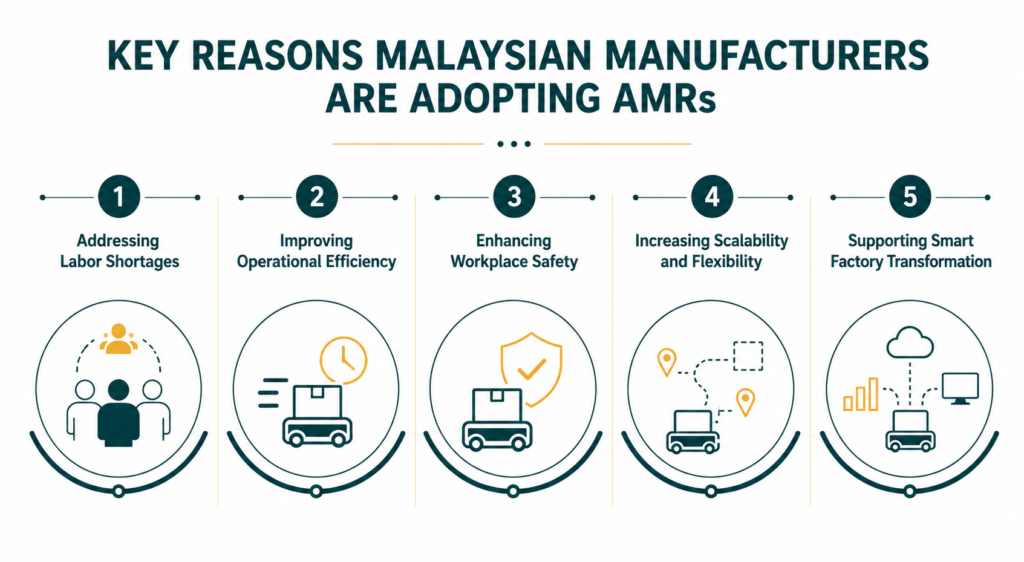
Key Reasons Malaysian Manufacturers Are Adopting AMRs
1. Addressing Labor Shortages
Malaysia’s manufacturing sector continues to face challenges in hiring and retaining manual labor for repetitive tasks. AMRs reduce dependency on human workers for material transport, allowing companies to allocate manpower to higher value tasks.
2. Improving Operational Efficiency
By automating internal logistics, AMRs help reduce delays between production stages. Materials are delivered precisely when needed, reducing idle time and improving overall production flow.
3. Enhancing Workplace Safety
AMRs reduce the need for forklifts and manual transport in busy factory environments. This lowers the risk of workplace accidents and creates a safer working environment for employees.
4. Increasing Scalability and Flexibility
Unlike conveyor systems, AMRs can be easily redeployed as production needs change. This makes them ideal for factories that frequently adjust layouts or expand operations.
5. Supporting Smart Factory Transformation
Autonomous Mobile Robots integrate with warehouse management systems and production software, enabling real time tracking and data driven decision making. This aligns with Malaysia’s Industry 4.0 initiatives.
AMR Benefits vs Traditional Internal Logistics
| Area | Autonomous Mobile Robots | Traditional Methods |
| Material Transport | Flexible, on-demand routing | Fixed routes or manual handling |
| Efficiency | Continuous and optimized flow | Often delayed by human labour |
| Safety | Reduced human-machine interaction risks | Higher risk from forklifts and manual movement |
| Flexibility | Easily reprogrammed for layout changes | Requires physical infrastructure changes |
| Labor Dependency | Lower reliance on manual transport workers | High dependency on manpower |
Example of AMR Application in Industrial Environments
Modern AMR systems such as the Oasis 300E SRL are designed for industrial-grade performance in manufacturing and logistics environments. These systems support automated material transport across factory floors, helping reduce manual handling and improve process synchronization.
Solutions provided by Chin Tech demonstrate how AMRs can be integrated into broader automation ecosystems, combining robotics, control systems, and material handling technologies.
Challenges to Consider Before Adoption
While AMRs offer significant advantages, successful implementation requires careful planning:
- Proper facility mapping and layout design
- Integration with existing production systems
- Network and data infrastructure readiness
- Workforce training and adaptation
Working with an experienced automation partner ensures smoother deployment and better long term performance.
Why Choose Chin Tech for Autonomous Mobile Robot Solutions
Choosing the right automation partner is critical for successful AMR implementation. The effectiveness of Autonomous Mobile Robots in Malaysia depends not only on the technology itself but also on how well it is integrated into existing manufacturing and logistics systems.
Chin Tech provides end to end automation support focused on practical deployment, system integration, and long term operational performance rather than standalone equipment supply.
- System Integration Expertise: Integrates AMRs into full production systems for smooth communication between robots, warehouse systems, and workflows, improving reliability
- Industry Focused Solutions: Designs each project based on real factory requirements such as layout and production flow to ensure practical performance
- Scalable Automation Approach:Allows manufacturers to start small and expand into full automation as operational needs grow
- Focus on Operational Efficiency: Improves manufacturing performance through reduced handling time, better workflow synchronization, and lower operational costs
- Support Across Implementation Lifecycle: Provides support from planning to deployment and optimization for stable long term performance
Get Started with Autonomous Mobile Robot Solutions Today
Speak with our automation specialists to explore how Autonomous Mobile Robots in Malaysia can improve your internal logistics efficiency, reduce manual handling, and support your transition toward a smarter and more automated factory.
Contact Our Team to Discuss Your Automation Requirements
Conclusion
The increasing adoption of Autonomous Mobile Robots in Malaysia is driven by the need for smarter, safer, and more efficient internal logistics systems. From reducing labor dependency to improving production flow, AMRs are becoming a core component of modern manufacturing strategies.
With integrated solutions from providers such as Chin Tech, manufacturers can accelerate their transition toward fully automated, Industry 4.0 ready operations.
Frequently Asked Questions
What are Autonomous Mobile Robots in Malaysia used for?
Autonomous Mobile Robots in Malaysia are mainly used for internal logistics tasks such as transporting materials, moving work-in-progress items, and delivering goods between production stations in factories and warehouses.
How do AMRs improve manufacturing efficiency?
AMRs improve manufacturing efficiency by automating material transport, reducing waiting time between processes, optimizing internal routes, and minimizing manual handling within production facilities.
Do Autonomous Mobile Robots require major factory changes?
No. Most AMR systems are designed to operate within existing factory layouts. They use advanced sensors and mapping technology to navigate independently without requiring fixed infrastructure such as tracks or conveyors.
Are AMRs suitable for small and medium-sized factories?
Yes. AMRs are scalable automation solutions suitable for SMEs. Manufacturers can start with a small number of units for specific processes and gradually expand their AMR deployment based on production requirements and budget.
What is the difference between AMRs and traditional forklifts?
AMRs operate autonomously using navigation systems and require minimal human input, allowing continuous operation in dynamic factory environments. Traditional forklifts require manual operators and are less flexible when production layouts or transport requirements change.